Showing posts with label long run. Show all posts

Tuesday, November 26, 2024

I'm Running A Marathon Soon

On Saturday, December 7, I will run my 35th marathon: the Tidewater Striders Marathon in Chesapeake, VA.

Why I chose this race
I came down with Covid at the end of July and I took the entire month of August off, except for three very short/easy runs in which I thought I was recovered. Those three very short and easy runs likely caused me to sink further into post viral fatigue, so I wasn't able to resume running again until the middle of September. At that point, I came back with run-walks to be 100% certain that I was well enough to run again. In total, I took seven weeks off of running. This post has all the details!

Having been through post-viral fatigue before, I knew that once I was out of the woods, I could train at full intensity. I ran 36 miles the week of September 23rd and 44 miles the week of September 30. I was back! Based on experience, I know that I don't need a really long training cycle to run a strong marathon. I just need an intense training cycle - jam-packing a lot of quality into 6-8 key weeks. As a coach myself, I don't recommend this approach to other athletes, but it's worked for me in the past. 

An ideal time to run a marathon would have been right around Christmas/New Year's - but there are no marathons within driving distance at that time of year. So my options were to go a bit earlier or a bit later. I quickly ruled out January because I didn't want to get on an airplane, so early December it was. My options within driving distance were Rehoboth Beach and the Tidewater Striders Marathon. Rehoboth is my PR and I didn't think I could replicate the magic of that day, so Tidewater it was! 

The Tidewater Striders marathon is a small race which currently has just under 100 registrants. However, there is also a 50K and 100K occurring at the same time, so it will feel slightly larger. I am familiar with the course because I set my 10-mile PR on that course back in 2021. The course is pancake flat! The downside is that it's two out-and-backs with little crowd support. And that's not much of a downside considering I will see Greg multiple times!

Training
How ready am I? Here is a graph of my training:


Thankfully everything went smoothly and we were blessed with ideal running weather throughout most of October. I did encounter quite a bit of wind on my 3 longest runs, but I still powered through it. And it could be windy on race day! As long as it's not hot, then I'm good to go.

My longest run was 21.5 miles, and I also ran a 20.4 miler and an 18.5 miler. (For some reason, I liked to be between the whole numbers this cycle). My goal marathon pace of 7:20 has felt very manageable and almost too soft, while I have struggled to hit paces below 6:40 for some of the faster workouts. I'm chalking it up to tired legs.

Shoes
When I ran Boston, I wore the ASICS Metaspeed Sky shoes. They were fun and fast, but not as responsive as I would like. I've decided to go back to adidas- my go to brand of womens running shoes. I typically race in the adidas Adios Pro 2. The "3" came out a few years ago but I stocked up on version 2 because of the higher heel drop. I was really hoping the 4th version would come out before this marathon but it's scheduled come out later in December. 

Just as I had decided on wearing a pair of the adidas Adios Pro 2, I had the opportunity to purchase a pair of the adidas Pro Evo 1. These shoes were released in very limited quantity, and they are almost impossible to find. Plus, with a price point of $500, I had determined that they were too expensive. But then I realized that I hadn't spent any money on running shoes this year because I received so many promotional pairs. When you look at it that way - why not splurge on them? The driver of the high price is the materials and the fact that they weigh less than 5 ounces yet have a full stack height.

I haven't tried them yet (they should be arriving in a few days) but I will do 1-2 short runs in them to make sure they work before race day. That's more than I did when I ran Boston in a brand new pair of ASICS! Let's just hope they fit because they were not available in the next size up.

Goals
My main goal is execution: to stay mentally strong and nail my fueling and hydration. Timewise, I am shooting for a PR (sub 3:15) but ideally closer to 3:12, maybe 3:10 if the shoes are truly that magical! (Although I don't want to give all the credit to my footwear.) Now I need to focus on resting, recovering, not getting sick, and picking out my race outfit. 

If I can pull this off, it will be the world's shortest training cycle ever! But I am relying on the endurance that I have built up over the years, not just in the past six weeks.


Sunday, November 3, 2024

Ode To My Running Routes

We're moving. And perhaps the biggest change with moving won't be the house itself, the mortgage payment or the commute. But the running options.

When searching for our new home, we found plenty of houses that we loved but that were, as I called them, "land locked." My definition of "land locked" means the only way out of your neighborhood is a narrow two-lane road that is not safe to run on. These houses were automatic deal breakers. Our new home will be run-able, but as I stated above, the running options will be entirely new and different. 

But in this post I don't want to talk about our future neighborhood. I want to wish a proper farewell to our home of 15 years, the home that got me outside every day instead of on a gym treadmill Monday through Friday. 

Here are the top 10 things that I LOVE about my running routes today, that have been part of my daily routine for 15 years. 

10. Variety. From my house I can run in multiple directions and through multiple neighborhoods. Even though I do tend to get bored of my same routes, there are places I can go if I really want a change.

9. Fresh Pavement. Within the past year, they paved my neighborhood with smooth asphalt and they did the same to almost all the roads I run on. There is nothing like fresh, smooth asphalt!

8. Safety. I run mostly on neighborhood roads and I have never once feared for my safety. I often encounter other runners and walkers. The roads are generally well lit. I typically don't run on thru-streets so the only cars on the road are those people leaving their homes in the morning.

7. Flat, Hilly, or Mixed. I can make my runs as hilly or as flat as I want them. There are some routes that are mostly flat, and some routes that are quite hilly. I usually choose the flat routes for easy runs. Those routes are not entirely flat, but the hills aren't very long or steep.

6. Wide Roads.
If you've ever watched one of my Instagram videos, you know that I run mostly on neighborhood roads. And there aren't many cars. This is thanks to the roads being wide. There is enough room for cars to be parked on both sides of the street AND for two cars to be driving on the street passing each other, AND for me. So imagine a scenario where you have cars parked on both sides of the road, and there are cars coming from both directions. Well, there's still plenty of room for me to run. The roads are that wide.

5. Perfectly Placed Hills. One of these wide roads is a hill that's about a quarter of a mile long. It's perfect for hill repeats. My hill repeats usually last 60-90 seconds and this hill is the perfect grade and distance. It's not too steep but it's definitely a hill. This hill is located about a mile and a half from my house so it's perfect to run the warm up and cool down there and back. There is another hill that's about twice the distance that I use for my 2-minute hill repeats. It's similar to heartbreak hill. It's not incredibly steep but it is long. Finally, there is an area that's almost completely flat but has one hill in it. A common workout of mine is tempo/hills/tempo so I can run the tempo on the flat portion and have the hill for the hill repeats in the middle.

4. Plowing in the Winter. They are very good about plowing my neighborhood and the surrounding neighborhoods. If it snows overnight or in the morning, I know that road will be plowed by the middle of the day. Last winter we had a few periods of heavy snow and I only had to use the treadmill a few times. There was one winter when Greg and I needed to do a long run before leaving on vacation. Our neighborhood was not plowed but we found one about a mile away that was plowed and it was a big loop we ran 14 times around.

3. A Track. I can run to my local track in 2.3 miles. Sometimes I drive there and sometimes I drive halfway there, depending on how long I want my warmup and cool down to be. But it's nice to have a track that's open to the public that is within running distance. I also have a group of friends who runs on this track most Tuesdays, which is nice. 

2. Ending at Coffee. I live less than a mile away from a plaza with a coffee shop, a smoothie place, and a grocery store. I like to finish my runs there and walk home with my coffee or my smoothie. Or even pick up some groceries afterwards!

1. The Perfect Tempo Neighborhood. About 2.5 miles away from me is a neighborhood that's mostly flat (just a few inclines and declines) and it goes on, and on, and on, forever. It's perfect for tempo runs and marathon pace runs. Sometimes I run to it, and other times I drive there so I can use my car as a water station. The roads are wide, there is no through traffic on most of them, and it's well shaded. I think this is what I will miss most of all. 

Many of these things will also apply to my new neighborhood, but in a different way. I think the biggest difference will be narrow roads and a generally hillier topography. Narrow, hilly roads instead of wide, flat roads. I am sure I will get used to it! There will also be things about the new area that will be better than my current area. 

We still have a bit more time left to enjoy our current house which we will miss dearly! Every time I run I take a moment to appreciate how "lucky" I got with this particular area in terms of running route options.

If you are looking to move to a different area and you are an avid runner, it's worth thinking about these things and really sizing up the running landscape before choosing a new home. 

Saturday, March 23, 2024

Boston Bound - Again!

I’m making my 4th trip to Boston for my 5th Boston Marathon in a few weeks. I know that sounds weird, but I ran the virtual in 2020 and I totally count it!

My first Boston Marathon was 2016. I ran it again in 2018, 2020, and 2022. I think every two years is a good way to run it regularly while still keeping it special. I’m considering of moving to every four years (the leap years) after this race. That is, of course, if I keep qualifying.

Training has looked different for me this cycle because the One City Half Marathon was my goal race. I tapered for it and recovered from it which meant to weeks of relatively low mileage (35 and 27). But considering I missed two weeks of training entirely before Richmond and still ran a strong race, I am not concerned at all.

The main point is that Boston has not been my focus and I don’t feel like I have invested that much training in it, relative to how much I typically train. But who knows, maybe less really is more. I have two 20-milers under my belt and one 16-miler. All other long runs have been under 16 miles. Yesterday I ran 20.12 miles at an average pace of 7:41 and I felt like I could have kept going. So I somehow am in the best shape of my life without having trained that hard.  I ran the 20 miles as 7 miles easy (8:23 average) 11 miles at marathon pace (7:11 average) and 2 easy (7:49 average). 

I do not have a time goal for Boston because the weather is so unpredictable. It’s a tough course and logistics are not ideal. That said, I think I could break 3:20 even in non-ideal circumstances. My half marathon predicts a time of 3:09-3:10 so I have some cushion! My fastest Boston was 3:26:54, and I am fairly certain I can beat that time if it stays below 65 degrees.

Bib numbers were assigned this week and I find it fascinating that the field gets faster and faster each year. Your bib number corresponds to you qualifying time: the lower the number, the faster your time was. Here is my history:

2018: Qualifying time of 3:21:54 and bib 12394
2022: Qualifying time of 3:18:57 and bib 12827
2024: Qualifying time of 3:16:04 and bib 12577

When I ran the race in 2016 my bib was 19448, but my qualifying time was significantly slower: 3:35.

My fastest qualifying time was 3:15:34 and I am fairly certain that I would have gotten a bib below 12,000 back in 2020 if the bib numbers had been typical. But with the virtual race things were different because not all entrants ran the virtual race and received a bib number. In any event, this will be my third consecutive Boston in the exact same starting corral. Now we just need to hope for cool weather because these bibs tend to be gigantic and best suited for crop tops or singlets – not sports bras!

I’m excited to return to Boston but not quite as excited as I was in previous years. This is probably natural because the more you do something, the less “special” it feels. As I mentioned earlier, I might reduce my Boston trips to every four years, provided I can still qualify. Greg and I have so many vacations on our bucket list, and we think the money would be better spent on extending our next African safari.

Who knows, I may just fall in love with the race all over again and insist on going back in 2026. Thankfully I have no nagging injuries like I did going into Richmond and I’m in an excellent spot mentally. My top priority is to have a fun Boston weekend with Greg and my friends, and my race performance will be what it will!

Saturday, September 17, 2022

End of Summer Training Update

We've reached that time of year when it's darker in the mornings and evenings, leaves are starting to fall off the trees, but yet here in the Washington DC area. . . it's still warm and humid! A few updates on how

it's been going.

Race schedule
My race calendar looks like this:

  • October 8: Hartford Half Marathon
  • November 5: Indianpolis Monumental Marathon
  • Thanksgiving: Turkey Trot 5K
  • January 15: Houston Marathon

There are 10 weeks in between Indianapolis and Houston, which is a very quick turnaround, but I wanted to do it for a number of reasons. I've always wanted to run the Houston marathon (I've done the half twice) and I also want a season to focus on the half marathon as the target race, so I will be choosing a target half marathon in late March.

New Training Approach
While I've been using McMillan coaches for 8 years, this is my first marathon cycle working directly with Greg McMillan himself. Up to this point, my weekly mileage has been in the low 50s and the marathon is just 8 weeks out. This week I will climb into the upper 50s, but that is still low for me. 

But optimizing training is all about experimenting. I've typically done well with very high mileage (in the high 70s) but there have been a few occasions when that has burned me out. And given that I have TWO marathons I'm training for, why not experiment with the first one with some lower mileage?

The thing is. . . mileage is just one piece of the massive training puzzle. Other pieces include the types of workouts, the frequency of workouts, fueling/hydration, stress levels and more. I think it's easy to get hung up on weekly mileage because it's a tangible, measurable thing. And as someone who loves analytics, mileage is definitely something I can get too focused on.

When I ran Boston last spring, I had to take 25 days off for Covid, and then another 9 days off just weeks before the marathon. And when race day came, I felt as fit as ever. I learned that I don't need to be so rigid with my training. I have a coach who is renowned for his approach, knows 100 times more than I do about running, so I am putting it in his hands. 

That said, the key to an effective coaching relationship is the communication. It's important for him to receive my feedback on how the runs felt so he can tweak the plan as needed. I am also experienced enough to tweak the plan myself in terms of moving days around.

After years and years of running 70+ miles per week during marathon training, I think I have established a solid endurance base. Endurance has always been my strength, so the ability to work on speed without having super tired legs is worthwhile.

The past 5 weeks of training have been all about TRUST. I have trusted that I am in better shape than my paces suggest due to the heat and humidity. I have trusted that the lower mileage could really work for me. I have trusted that runs that feel bad are a product of tired legs and/or the weather.

A few key workouts
I'll recap a few of my workouts here so you can get a sense of what training has been like.

17.6. miles, 8:52 pace on September 3. It was warm and humid so I kept it really easy. Although when I got back home, I started to see black spots and my vision was slowly getting more and more black. I lied down on the kitchen floor and felt horrible for a few minutes but then I was fine. While everyone struggles in the humidity, I have found that I am susceptible to heat exhaustion and it's not entirely safe for me to be running this kind of distance in the heat. But I did it and survived. Hydration was a major focus for the rest of the day. 

9 x 1000m Cruise Intervals with 200m recovery jogs on September 5. Nine might seem like an awkward number, but Coach Greg prescribed 8-10 so I thought 9 would be a happy medium. I was encouraged by this workout. I was extremely consistent with my paces in the 6:44-6:50 range and everything felt controlled. Given the humidity and short recovery jogs I was surprised I could run at that pace for so long. 

Marathon Pace workout: 10 miles at 7:37 pace on September 10.  Greg's company sponsored a local 10-mile race which meant that many of his co-workers were running it. We both signed up for this last spring and my intention was never to race it full out. Due to the humidity, I adjusted my goal pace from my actual target of 7:15-7:25 to 7:20-7:30. This was not smart. I KNOW that I need to adjust more like 30 seconds per mile in the humidity, not just 5! This meant that I ran the first half of the race too quickly and by mile 6 I felt like I was running half marathon pace just to maintain it. And then it felt like a 10K, followed by a final mile up a 120 foot hill that was a death march. So I ended up averaging 7:37, which is probably what I should have targeted initially, and it would have felt much better at the end. 

20 miles, 8:27 pace on September 16.  I did my long run on a Friday this week. I have a 10-mile marathon pace workout on Tuesday and looking ahead, Tuesday's weather is the hottest of the week! So I decided to move that marathon pace workout to Monday, but I wanted two full recovery days post 20-miler. So today is a rest day and tomorrow will be an easy day.

This 20-miler did wonders for my confidence. It was cooler and less humid and running a pace of 8:00 towards the end of the run felt like 8:30 a few weeks prior. It's amazing how much weather matters! My average heart rate for this run was 154, and it was also 154 for the 17.6 miler. But this run was further and faster by 25 seconds per mile! So that kind of tells me that maybe 25 seconds per mile is what I need to use in terms of adjusting for the humidity. 

New Balance SuperComp Trainer
Shoes I am loving & not loving
Road Runner Sports gave me a pair of the New Balance SuperComp Trainer in exchange for a review of it on my Instagram. I didn't ask them for this shoe and I had never heard of it. But once I learned about it and wore it on a few runs, it quickly became my new favorite shoe. 

I don't like wearing carbon fiber plated shoes in training because I like to save that magic for race day. And this shoe does have a carbon fiber plate. But it's meant to be a training shoe due to its weight. It does feel heavy in the hands but light on the feet. And even though it has an 8mm drop, it's more friendly to my Achilles than the ASICS Nimbus, which has a 13mm drop. This is not at all what I would have expected, but I guess it has to do with how the shoe fits me overall and how it changes my stride. I've worn it for two long runs, including the 20-miler, and it performed like a champ. 

And as for "saving the magic" of carbon fiber plate for race day - I feel like I am at a disadvantage with the heat and humidity so the carbon fiber plate levels the playing field! 

As for the ASICS Gel Nimbus, I think I have fallen out of love with that shoe as quickly as I fell in love with it. I really loved the Nimbus Lite for long runs, but when they came out with Version 3, it was too big for my feet. By the time I realized this, it was too late to exchange the shoe for a smaller size. (The downfalls of letting shoes sit in your closet for too long). The regular Nimbus 24 initially felt great but the more I ran in it, the more I realized it was too big as well. I kept stopping during runs to make the laces tighter. Additionally, the arch support in the Nimbus 24 is way too noticeable. 

It's possible that the previous versions (Nimbus 23 and Nimbus Lite 2) were simply superior shoes and maybe the upcoming versions will be better. But as for now, I am not nearly the Nimbus fan I once was. 

My current rotation is the New Balance SuperComp Trainer for long runs, the Adidas Adios Pro 2 for races, the Brooks Ghost 14 and ASICS Nimbus 24 for easy runs, and the Adidas Adios 4 for speed work.

Wednesday, March 30, 2022

3 Weeks Until Boston and OUCH!

With less than three weeks until the Boston Marathon, an injury has popped up, bringing my training to a complete halt. I'm going to document all the details here, mostly so I can go back and reference them, but the punchline is that I am having issues with SI joint inflammation; something completely new to me. The joys of growing older! 

How it started
On Tuesday, March 15, I was doing deadlifts with the hex bar during a strength training session with my coach. I have done these many times in the past and I was using a slightly lighter weight than I had used in my previous session. As I completed the set of 5, I noticed a crunchy/pinchy sensation in my lower back/left upper glute. It was so minor that I didn't even tell my coach! When I do strength training I get little things like this a lot. I did a little jog-in-place to shake the legs out but the weird sensation remained. 

Ever since that session I have had a mild pinching sensation around the left SI joint. I didn't even realize this was my SI joint because I have zero experience with back injuries. I continued to run without any problems or pain. The following Saturday, March 19, I ran 18 miles with 10 at marathon effort (pictured). Even though I felt a little pinch the whole time, it didn't impact me at all and seemed totally minor.

How it progressed
The first red flag was on the following Tuesday, one week after the deadlifts (March 22). I ran a very challenging workout that combined track intervals (1600, 1200, 800, 400) with road miles in between each interval at tempo effort. The workout went really well and I had no pain whatsoever. I hit all my desired paces. Greg took videos and my gait was totally even and balanced. 

When the workout ended, that minor pain in my lower back became much more prominent. In fact, it hurt to walk! I walked a little bit and then I began my cooldown. My cooldown was very uncomfortable. I noticed that the slower I ran the more it hurt, but I obviously wasn't going to run super fast on a cooldown. So I cut the cooldown short because my lower back/SI joint was painful. 

I told my coach about it and we had a zoom meeting to discuss it. At that point it really seemed like it was a tight glute medius. That seemed to be the bigger problem than the pain around the joint. I'm guessing that the joint pain was exactly the same but that the running caused all the surrounding muscles to tense up, so now I had muscular tightness as well.

March 22 track/road workout
I went to physical therapy the next day and my PT said that my glute medius was extremely tight and also that one leg was slightly longer than the other. He did something to get the legs the same length again and did deep tissue massage on the glute. We also did some exercises to get me using the glute normally. I told him I had a hill workout the next day and he said as long as it didn't bother me while running, I would be fine.

So the following day, Thursday, I ran a hill workout with tempo runs in between the hill sprints. Running up and down hill felt fine. The tempo run felt fine. I could feel a slight pinch, but it was totally mild. BUT - just like Tuesday, the cool down run was very painful. I was stiff and it was hard to move. 

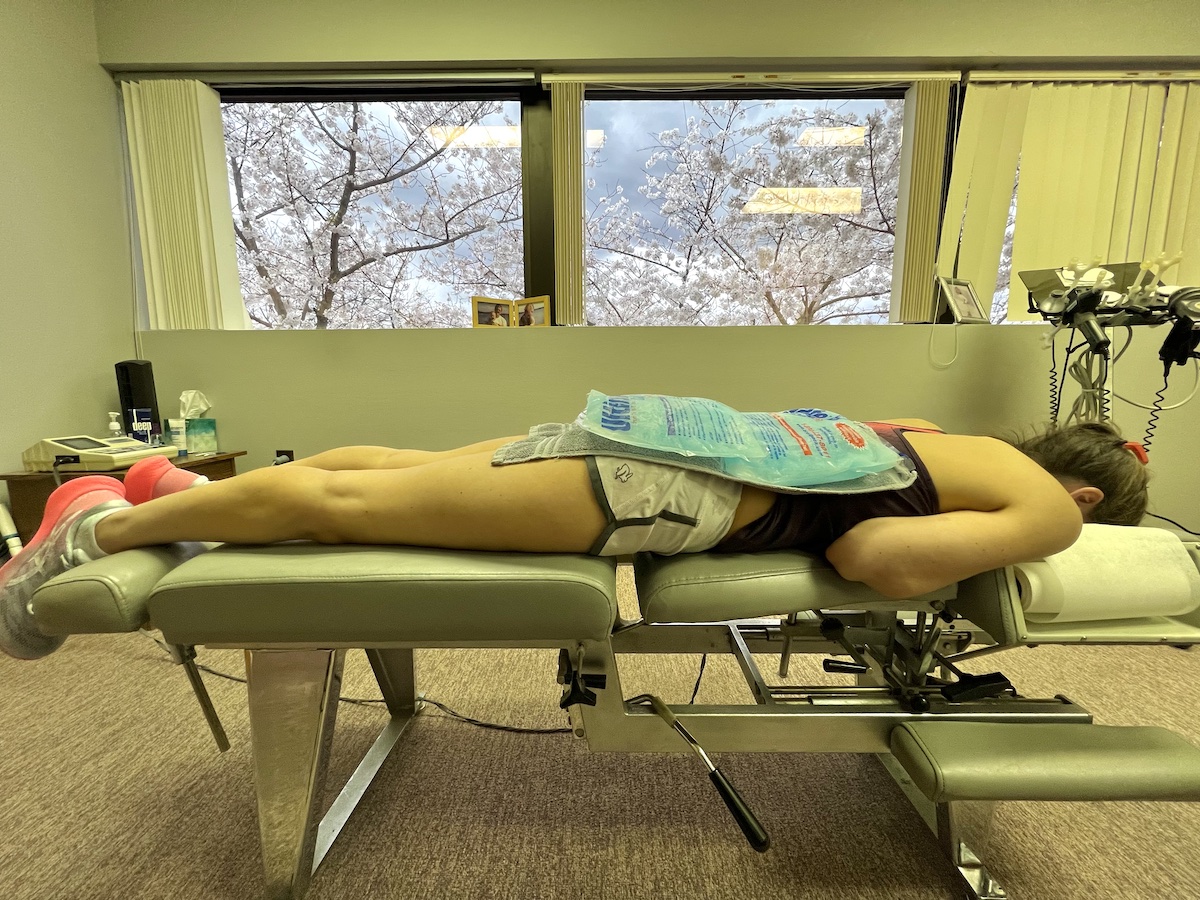
By Friday, my glute muscle seemed to be in good shape but now the lower back pain around the SI joint was more prominent. That's when I decided to see a chiropractor. In retrospect, I should have gone to the chiropractor the day after I deadlifted (9 days earlier) but I didn't think to do that because it was such a minor issue. He told me my SI joint was out of place and he gave me an adjustment to put it back in place. I unfortunately didn't feel any relief from the adjustment but he said it worked so I assumed everything was ok. 

The final straw
The next morning (March 26), it was time for my longest run of the cycle: 23 miles. My plan was to run from Leesburg to Falls Church on the WOD so that the run would feel like it had a purpose vs. an out and back. Greg and I would drive to Leesburg, he would run the first 8 miles with me, turn around, get the car, drive to Falls Church and pick me up. 

I was nervous about this run and I was debating if I should even do it. On the one hand, I had visions of the run making the issue so much worse and having to stop on the trail. On the other hand, things felt fine and I really wanted to do the 23-mile run. I was totally looking forward to it and once that was complete I told myself I could take a few days off if needed. I wish someone had told me that you should take it easy the day after a chiropractic adjustment. But I hardly ever get adjustments, so this is all new to me. Also, if I knew that was the case, I may have delayed the adjustment until after the long run!

Greg and I ran 8.5 miles together and then it was time for him to turnaround. I did feel the pain around my SI joint, and it was slightly worse than it had been on the previous weekend's long run. But still manageable. When he turned around, I was fairly confident (let's say 80% confident) that I would be able to make it to 23 miles. Or at least 20, which would still be plenty. 

I continued on my own and I stopped briefly at mile 10 to toss my water bottle in a trash can and take a gel. I noticed that my glute and hip were a little annoyed, and the first few steps after the stop were difficult. But once again, totally manageable. But after another mile or so, things really started to go south! My hip started seizing up, my glute was in pain, and my lower back hurt even more. Over the course of 5 minutes, everything started going crazy until I was forced to stop. At 12.09 miles.

I was about a mile away from a shopping center where I could sit inside a Starbucks, call Greg from my Apple Watch and wait for him. But I couldn't walk! I just stood there on the side of the trail feeling paralyzed. Lots of people asked me if I needed help but I told them I would be fine and I was going to call for help. Thankfully, I was very close to a break in the fences/grass/trees that surround the trail and was able to slowly get myself into the back of a parking lot of an office park. If this had happened at mile 15, 16, or 17 I would have been screwed because that's "no-man's land" and there are very few trail exit points.

The pain got pretty bad and it brought me to tears. I knew that Greg still had to run 4-5 miles back to the car in Leesburg so I called my friend Cheryl who lives in Reston. I knew I was in Reston (it was technically Herndon) and I gave her the name of the of the business I was standing in front of so she could find it on Google and come to me. The main reason I needed Cheryl was because it was 49 degrees and I was wearing a tank top and shorts. That's perfectly fine attire if you are moving, but it got cold very quickly when I stopped moving. She found me shivering with blue lips and gave me her jacket as I sat in her warm car. There, she gave me tons of info on SI joint pain (she's dealt with it) and we waited for Greg to come pick me up. Greg called the chiropractor who I had seen the day before and got me in to see him immediately. Thank goodness!

The chiropractor said the SI joint was still in alignment but now the hip was out of alignment and all the muscles around the glute and hip were extremely tense. He corrected the hip, but I still had a ton of difficulty walking around the rest of the day. 

Recovery
I spent the rest of Saturday and all day Sunday icing the area, taking Aleve and using my Rapid Reboot compression system for the hips and glutes. I already had a massage scheduled for Sunday and she did deep tissue work and cupping. Most all movements were difficult. Especially going up stairs, bending over and sneezing. Sneezing was the worst of all. 

On Monday I was back in my PT's office for dry needling and a walk on the Alter-G anti-gravity treadmill. The walk was to help my brain realize that everything was okay, I could walk normally, I didn't need to tense up and brace for pain. On Tuesday I was able to get in with my sports medicine doctor who finally provided me with some clarity on the situation. 

Official Diagnosis
According to my doctor, it's most likely SI joint inflammation with tension of the surrounding muscles and inflammation around the hip (trochanter). She said there was a slight possibility that I had a bulging disk, which could only be ruled out through MRI. I definitely wanted to rule out a bulging disk, so I am getting an MRI next week.

Because it's most likely inflammation and muscle tension, she prescribed a therapeutic dose of Naproxen (NSAID) and continued PT. If my symptoms don't improve within a week I will go back for a cortisone injection. Normally I would try to avoid an injection, but with Boston coming up, I will do whatever is needed to get to the start line feeling good.

So for now it's rest, PT, and NSAIDs. Once I start to feel better I will attempt running again. I'm going to be fairly conservative, as my goal is to get to Boston feeling good. I don't think I can salvage much training at this point. Most likely it will be a full week off of running and then short, easy runs as I gradually return. 

I can now walk with a normal gait and the pain isn't anywhere near what it was over the weekend. I am seeing dramatic improvements each day and I hope this trend continues. This certainly sucks, but I wasn't trying to PR at Boston anyway. I just want to be healthy when I get there. 


Saturday, March 12, 2022

Boston Marathon Training & Amazon Sponsorship

It's been a while since I have updated my blog. The last time I posted I had just made a full recovery from Covid and was starting to train again. 

The big news is that Amazon reached out to me about a month ago, offering to sponsor me in the Boston Marathon! They found me on Instagram and said they were running a campaign with the Boston Marathon around the 50th anniversary of women running the race.

Amazon is an official sponsor of the Boston Marathon and as part of their sponsorship, they are promoting female runners for this 50th anniversary. What does it mean to be sponsored by Amazon? They have covered my travel expenses and my registration fee, they have given me loads of free gear (of my choosing) along with some extra cash and perks. In return, I share my training on social media and the gear that I am using from Amazon. 

Here is a link to Amazon's Boston Marathon page, which features the women they are sponsoring.

Here is a link to my personal storefront with all my favorite gear.

I have been enjoying working with the PR agency that represents the Boston Marathon & Amazon on this campaign. It's actually somewhat surreal because I tried for 8+ years to qualify for the Boston Marathon and now this amazing opportunity has come up!

Training Update
Training is going really well, especially considering I had to take over three weeks off in January. I've been able to do all my workouts and hit all my paces without feeling burnt out and without any niggles or injuries appearing. 

For long runs, I have switched from the Nike Odyssey React to the ASICS Gel Nimbus Lite, and that has made a huge difference with my Achilles tendinopathy. The Nike is a bouncy shoe with a 10mm drop. The ASICS has a 13mm shoe and doesn't compress as much. They don't even make the Nike Odyssey React anymore, but I had stock piled a few pairs. The good news is that the long runs aren't painful for my Achilles like they used to be. The problem still exists, but it's milder than it was before. 

My long run progression has been as follows:

February 11: 10 miles easy (8:51 average)
February 19: 14.1 miles easy (8:31 average)
February 26: 17.5 miles easy (8:19 average)
March 5: 18 miles with 8 at marathon pace, MP miles averaged 7:20
March 11: 20.2 miles easy (8:41 average)

I am happy with my endurance and stamina. I have been logging 55+ miles a week for the past four weeks, and I'm on track to run 70 this week. My speed isn't what it once was, as evidenced by a set of 9 x 800m. Those averaged around 3:17, which is slower than my usual 800m time, but it was windy that day so I can't complain. 

I continue to have weekly strength training sessions with my coach and those are one hour long. I do a shorter version of the exercises she gives me on one other day of the week. I want to prepare my quads for all the downhill of Boston. 

I got my bib number and I will be in the same corral that I was in back in 2018. Wave 2, corral 5. Even though my qualifying time is 3 full minutes faster, the race has gotten more competitive so I haven't moved up. 

I am not planning on running any races between now and Boston. I am registered for the Shamrock half, but when I got Covid, I decided that I didn't want to sacrifice training for the taper/recovery needed to run an all-out half marathon. I had also been registered for a 5K on the Friday 10 days out from Boston, but they canceled that race due to construction on the course. 

So everything is coming together nicely and I am thankful for every day I am healthy and able to run. I am cautiously optimistic about this race, knowing that anything can happen between now and then! Exactly two years ago they canceled the race, so now I'm not ruling anything out. I'm taking things one day at a time and I'm so thankful to be training for such an amazing marathon. 

Sunday, April 26, 2020

I ran 90 miles this week. Here's what I learned.

After running 26.2 miles on Monday to commemorate the Boston Marathon that never happened, I proceeded to run a 90-mile week. The idea to run 90 miles in one week came from my coach. The idea to start it off with a marathon was mine. Together, we make a crazy team!

Why run a 90 mile week? With no races on the calendar, my coach thought it would be a good way to challenge myself and also discover what I was capable of. I wasn't trying to make any fitness gains. In order to do that, I would have to string multiple high mileage weeks together, combined with marathon-specific workouts. Rather, I was trying to see how my body would respond to the 90-mile week and "learn" how to do it safely.

If I do end up running a 90-mile week in future training cycles, I most likely will not kick it off with 26.2 miles on a Monday. But even still, I think my experience will translate to future cycles.

Also, there is no better time to try this than right now:

  • The weather is still cool enough to push myself (I would not attempt this in the summer)
  • I don't have to physically go to work, which means I have extra time in the mornings
  • I don't have to physically go to work, which means I can wear recovery boots while working
  • I'm not training for anything in particular, so my training doesn't have to be targeted
Without having any commitments aside from working from home, I had the luxury of trying something new. I was confident in my ability to achieve this goal, but I wasn't going to injure myself in the process. If something felt strained or "off" I would shut it down and not risk it. I always pay close attention to how I am feeling during heavy training, and this week was no exception.

First, let's see how 90 miles looks in the grand scheme of my training over the past year. While my mileage was relatively low the week before, it did include a 5K time trial on Thursday, in which I pushed very hard.

Weekly mileage for the past year
As you can see from the above graph, that 90 mile week all the way to the right is by far the highest. It's important to note that I have been consistently running in the 60s and 70s for a long time, so it's not like I was able to do this out of the blue. I have been logging this type of mileage for at least the past 3 years. I have been running 7 days a week for the 4 years, so this is something that I have built up to over time. I do not recommend that someone who typically runs 40-50 miles a week try this.

Monday: 26.2 miles at 8:23 average pace
I wrote a detailed blog post about this so I won't go into the details here. I did spend the rest of the day prioritizing recovery. I was dehydrated so I drank plenty of water. I was thirsty for the three hours following run! I also spent 30 minutes in my Rapid Reboot compression boots. I wasn't really hungry for the rest of the day. We ordered a Mellow Mushroom pizza as my post-race lunch but I wasn't hungry for it until about 2-3 hours after the run. And even then I only had one slice. For dinner I had two slices of pizza plus a salad. This was really not much food, but I didn't have a huge appetite. Greg and I took a walk around the neighborhood in the evening. I think this helped in getting blood flowing through my legs.

Unfortunately, I didn't sleep very well that night, probably due to the adrenaline of the experience. Or maybe because I had a soda late in the day. I had a Pepsi shortly after CIM and I realized how satisfying soda is post race. I try to limit my soda (I had gone cold turkey for six months last year!) but I do treat myself occasionally.

Tuesday: 7 miles at 9:31 average pace
Weather: 46 degrees, partly sunny, light breeze
Shoes: Brooks Ghost

Tuesday, April 21
It was definitely a shock to myself to run the day after a marathon. I wore my tall compression socks for calf support and they felt nice. My legs were not "sore" in the traditional sense, but they were stiff and dead feeling. The only "watch out" that I noticed was that my right Achilles tendon was achey. But the more I ran, the better it felt. The first mile was definitely the hardest. I felt pretty good for miles 2-5, but then my legs got tired for the last two miles. My energy level was high and aside from my beat up legs, I felt good.

I took an Epsom salt bath and spent more time in the Rapid Reboot. During the Epsom Salt bath, I noticed that I had a blister on my big toe. I hadn't really felt it before then, but I noted that I should put a blister Band-aid on it for the next day.

My legs felt tired and achey all day, but there was no one particular area that hurt more than it "should". This is where knowing the difference between a normal ache and an injury ache is important. Everything just sort of felt equally tender and abused-- I couldn't pinpoint any real problem areas in particular.

Wednesday: 10 miles at 9:21 average pace
Weather: 38 degrees, partly sunny, light breeze
Shoes: adidas Ultra Boost 20

I tried wearing the same Nikes that I ran the marathon in, but I had to take them off after the first few steps. My toes were still tender from the marathon and I needed a shoe with a roomier toe box. When I put on the adidas Ultra Boost, it was like a massage for my feet. My toes had plenty of room to spread out and the cushion was so plush.  I wore compression capri tights, which felt great on my hips, quads, and hamstrings.

Greg ran most of this run with me and I was happy he stayed with me at my slower pace. Once again, the first mile was the hardest and then my legs loosened up the more I ran. I had a good amount of energy and I was encouraged by how smooth the run felt.

I showered and had a 9:15am conference call for work. After that call was done, a wave of fatigue came over me. I couldn't keep my eyes open. Sleep overtook me and I was out cold for an hour. When I woke up, I felt like I could barely move. I was extremely groggy. But eventually I got going and continued with the workday. I honestly felt like crap for the rest of the day and I realized that my lack of sleep on Sunday, Monday, and Tuesday nights had caught up with me. Allergies were also a factor, as I was sneezing my head off. I drank a ton of water and I ate really healthy foods. I was in bed at 7:30 and asleep by 7:45.

I told myself that if I still felt crappy in the morning, I would end my quest for a 90-mile week.

Thursday: 10 miles, with 6 tempo at 7:36 average pace
Weather:  45 degrees, overcast, no wind
Thursday, April 23
Shoes: adidas adizero Tempo 8

I woke up feeling refreshed after 9+ hours of sleep, so I figured I would continue on with the program. I couldn't believe my coach put a tempo run on the schedule! I told myself that tempo meant "faster than easy" and I would solely go on effort, not pace. I warmed up for 2.6 miles and then started the "tempo" run.

I managed to run splits of 7:48, 7:44, 7:36, 7:31, 7:33, 7:25. I am not sure how I did that just three days post marathon, but I did. It was hard and I felt like I was running a pace of about 6:50-7:00 towards the end. The cool down was pretty rough, but I managed to knock out 1.4 miles to get to 10 for the day.

My legs felt totally dead afterwards, but I was proud at how well they held up. I was tired and lethargic for the rest of the day, but it wasn't nearly as bad as Wednesday. Thank goodness I didn't have to look presentable for work or go anywhere!

Friday: 10 miles at 9:21 average pace
Weather: 50 degrees and light rain + light wind
Shoes: adidas Ultra Boost 20

This run was pretty much an exact replica of Wednesday. Same shoes, same pace. Starting at around 10:00 and gradually getting faster with no sub 9:00 miles. The weather made it unenjoyable, but thankfully Greg joined me for the first half. My energy level was high but my legs had no pep in them.

As for my fatigue during the day, it was much improved by Friday. My energy level returned to normal. I attribute this to drinking loads of water + electrolytes in the previous days, and finally getting caught up on sleep. Plus, the marathon was now 5 days behind me so I was generally starting to be less beat up.

Saturday: 19 miles at 8:38 average pace
Weather: 47-53 degrees, partly cloudy with no wind
Shoes: Nike Odyssey React 2
Saturday, April 25

I had no idea how this run was going to go. My coach had 18 on the schedule, but I decided to run 19 instead for COVID-19. I try to be "cute" whenever I can. I called it "Flatten the Curve of COVID-19 Miler" as a reason to run the flattest possible route. I had already paid my dues with hills on Monday and if this run was going to happen, I needed to minimize hills! My route had 293 feet of total gain, which is very little over 19 miles.

For this run, I prioritized fueling and hydration. I parked my car in a flat neighborhood that had many interweaving roads. I put a bottle of water + a bottle of Generation UCAN in the car, and made sure to drink early and often. Normally for an 18-miler I drink Generation UCAN beforehand but then I don't take any other fuel during the run. But I figured I would be going slower, which would mean more time spent running. I definitely did not want to crash.

I started out conservatively at a 9:11 pace for the first mile. I projected that my average pace for the run would be somewhere between 8:50-8:55. But I just "felt" my way through the run an ended up going faster without trying to. I decided I would hammer the last mile and dropped the pace down to 7:45. I never would have thought I could do that!


I'm not sure if it was the weather, my fueling, the hydration, or a combination of these, but I felt really good the whole time. I tried napping afterwards, but I wasn't tired enough to fall asleep! I felt really good the rest of the day and I even did laundry! That night, Greg and I treated ourselves to curbside takeout from Sweetwater, a delicious local restaurant that brews its own beer.

Sunday: 8 miles at 8:48 average pace
Weather: 50 degrees and raining
Shoes: Brooks Ghost

This run went smoothly and a lot easier than anticipated. I was expecting to run it in the 9:00's but my legs carried me faster. I was feeling so good that I ran the final mile in 8:15, capping off a 90.2 mile week. I could have gone farther with no issues, but I decided to stick with the plan. I'm guessing that the 19-miler didn't take that much out of me, since I ran it at a conservative pace. Typically I run long runs at pace of 7:55-8:10, so going slower helped preserve my legs for Sunday.

I ran 90 miles in one week at an average pace of 8:46.

And I feel good today! I definitely plan to take it easy next week, although I feel like I could handle a "normal" week of training without any problems. Best to quit while I'm ahead and feeling good. Here are some interesting stats:

  • During Saturday's long run, I hit 25,000 miles in my training log, which I have been keeping since January 2008.
  • I am now on day 104 of my run streak, averaging 8.3 miles a day since Jan. 14
  • My longest streak is 122 days, so I have not beaten that yet
  • Half of the mileage was completed in two runs (26.2 + 19) both in the same pair of shoes

What I learned
Primarily, I learned that if I am sensible with my paces, I can handle a 90-mile week without running doubles. However, this would be much more of a challenge if I had to commute to a job every day and get dressed up for that job. I still think I could do it, but I would be more stressed with the
logistics, and any kind of stress wears the body down even more.

Sleep is key! My mid-week bout of fatigue was no joke. I was so tired on Wednesday. Once I caught up on sleep everything was okay, but the sleep deficit was hurting me.

Hydration is key! I started the week dehydrated from my marathon. Of course, that was the warmest and most humid day of the week. Any other day of the week would have provided better conditions. But regardless, I need to stay on top of my water intake.

Warm epsom salt baths are amazing! I took a Dr. Teal's Epsom salt bath every day and they were so soothing. I really think this helped keep things loose. I could even multi-task by drinking water from the faucet.

Keep the easy runs easy. On my easy days, I let my body dictate my pace, not the Garmin. I would naturally speed up as my legs loosened and usually would feel better the more I ran.

In terms of aches and pains, the most achey thing all week was my mid to lower back. I kept asking Greg to massage it and I applied Salonpas patches. I really, really wanted to get a massage. It's better now than it was a few days ago. I think Thursday was the worst of it.

I wasn't noticeably more hungry than I normally am, but I was noticeably more thirsty.

Finally, the fact that I kicked all of this off with a 3:40:02 marathon means that I could run a marathon much faster than that! My endurance is really strong right now and the irony is that there not a single marathon in sight. Nevertheless, I enjoyed this challenge and I am glad I took the opportunity to run a lot before the weather gets too warm for me.

Sunday, February 23, 2020

Boston Marathon 2020: 8 weeks to go

Since recovering from my posterior tibialis tendonitis injury, my training has really taken off. I kicked things off with a 10K on February 2, and then I got back into the full swing of marathon training. Boston is now 8 weeks away and my training for the past four weeks looks like this:


From a weekly mileage standpoint, the ramp-up looks like this:

Week of Jan 20: 35.1
Week of Jan 27: 44.7
Week of Feb 3: 58.0
Week of Feb 10: 61.9
Week of Feb 17: 73.5

This might seem like I ramped up too quickly but in late December and early January, I had been logging substantial mileage. It took me a full month to get back to where I had been before the 5 days off I took.

Training Highlights
My two most recent long runs have been very encouraging. As I discovered during my 10K, my endurance didn't seem to suffer from the time off. Therefore, when it came time to run 15 miles and then 19 miles, my legs performed really well. 

Last weekend, I was prescribed 2 hours at a pace between 7:55-8:05. It was a perfect-weather morning and Greg and I ran together on the W&OD. We ended up doing a progression run from 8:25 down to 7:33, with an average pace of 7:53. I was very pleased with that. My legs felt energized the whole way through and there were some notable hills, too!

On Thursday of this week, I was prescribed 3 x 3 miles at half marathon effort with a mere 3 minutes recovery jog in between. The splits were:

6:57, 6:50, 6:50
6:52, 6:48, 6:50
6:52, 6:52, 6:55

I was very pleased with how everything felt and that I didn't feel like I was REALLY pushing until the last two miles. Including warm up and cool down, this was 13.6 miles on Thursday.

Thursday, Feb. 20
And then, just two days later, I went out for 19 miles. Yikes. Instead of hunting hills I ran a flatter route than usual to give my legs a break. I didn't expect this to be a progression and at the start of it I told myself the only goal was to get the miles done. I started at a pace of 8:37 and finish in the 7:40s, averaging 8:05 for the 19 miles. This was one of those runs that I just went on autopilot. At mile 12 I thought I would be in serious trouble come mile 16 based on how tired my legs were. But the run continued to be manageable, although uncomfortable.  I told myself I could stop at 17 miles-- that would be plenty considering I had only done 15 the weekend before. But then I got to 16 and bargained with myself to get to 18. And of course once I got to 18, I realized I would be able to run one more. So, 19 miles at an average pace of 8:05 just two days after 9 miles at half marathon pace!

I think that this type of thing will really build fitness so long as I can stay healthy. I did a recovery run today and even though my legs were dead, I was able to get through it without anything feeling off or painful. Including my foot!

And before moving on to the next topic, I would like to thank the weather gods for perfect weather during nearly all of my hard workouts this season. It has only snowed once, and it was a very small amount. I know many people are unhappy about this, but it has been great for my training. The irony is that I just got a treadmill over the summer and fully expected to get some use out of it this winter. But it has not been necessary. The worst I have dealt with is cold rain and wind, which isn't pleasant, but it's definitely manageable.

Up Next: The One City Half Marathon
I'm guessing my coach bumped me up to 19 miles yesterday because I have a half marathon next weekend, which is 7 weeks out from Boston. So after that, there won't be many weekends left for long runs. Especially considering I am also running the Cherry Blossom 10-miler.

I posted my half marathon pace workout to a running forum an the feedback I received from multiple experienced runners was that if I can average a pace of 6:52 for 9 miles in training, which I did, I should definitely be able to hold that in a half marathon race, and probably faster. That seems really intimidating to me, but logically it should be true. Especially since my legs were then able to handle 19 miles two days later. I didn't kill myself during that workout to get to those paces.

So that means I could likely run a sub 1:30 half marathon on Sunday. The weather is looking close to ideal (28 degrees at the start, 33 at the finish) so it really could be my day to crush it. I have an "elite" bib so I'm going to work hard to live up to that bib! Right now I think I will start the race at a pace of just under 7:00 and try to be in the high 6:40's by the end of the race.

Shoes
I was recently interviewed on the Run Farther & Faster podcast about my experience with the Nike Vaporfly Next%. Given that I have two pairs of these shoes with only 45 miles each on them, will I
Saturday, Feb. 22
wear them again?

For the half marathon, I will be wearing the Adidas Adios 4. It's the same shoe I wore for the 10K and it's really light. I like to be able to feel the ground under my feet, and I can't do that in the Vaporfly.

As for Cherry Blossom and Boston, I am not sure. I think I will probably stick to the Adios for Cherry Blossom, and only use the Vaporfly Next% in Boston if my foot is feeling 100% recovered and the weather is good enough to PR in. I'm not going to risk injury unless I think I could run the race of my life!

After having run a 10K, 2 half marathons, and a full marathon in the Vaporfly Next%, I don't think the shoe made me faster than I would have otherwise been. However, I recovered very quickly from both of those half marathons and was able to jump right back into training. And one of the benefits of the Nike Vaporfly is that your legs recover faster. Also, I did a 16 mile run with 13 at marathon pace and I felt like the shoes did take about 5 seconds per mile off my pace during that run. It was unbelievably fast. Of course-- the only time I experience their super speed powers is a training run! So. . . I am not giving up on the shoe entirely. Just for the immediate future.

Sunday, December 1, 2019

CIM: Training Cycle in Review

I'm wrapping up my training cycle for the California International Marathon (CIM) and I feel great. I'm noticing a huge difference between how I feel mentally between this cycle and my Shamrock cycle in the spring, when I DNF'ed.

Last spring, I was feeling really stressed. I was in the process of interviewing for new jobs and exploring multiple opportunities. I also felt like I had over-scheduled myself in general and I was feeling really overwhelmed trying to fit everything in.

This cycle, I am perhaps the calmest I have ever been. I don't have anxiety about my race, my
schedule, my job, or anything else in my life. And that has made all the difference. For the past several years I have realized how much stress and anxiety were holding me back, but now that my job is less political, I feel particularly chill.

Ironically, I have more responsibility and more work travel than ever before. I'm the Chief Marketing Officer of a tech company, which means I'm not only responsible for marketing, but helping to steer the direction of the business. In November, I traveled to Indianapolis and Providence for work, participating in all-day meetings, gave a presentation to a room full of people, but never once felt overwhelmed. Why? It's because I don't have to deal with politics at work. I don't think that anyone is out to get me, I'm not being micro-managed, and my colleagues aren't creating stressful situations for me. Most of the stress over the past 5+ years of my life has been work stress relating to people, not the work itself. I'm fortunate to I have a job where I'm empowered, trusted, and invested in the future of the company.

The commute is shorter with less traffic (25 minutes in the morning, 35 minutes in the evening) and I work from home about once a week. I don't think I realized how much my previous commute and the work environment was taking a toll on my overall stress levels. I have especially noticed this in my ability to recover from workouts and races. After the Columbus half, I ran a 73-mile week. After the Indianapolis half, I ran a 77-mile week. Both races were PRs and I felt good for the weeks following them.

I'm starting my training recap blog with this because I think the lack of stress has been the single most important factor in my fitness gains:

  • I am sleeping better
  • I am recovering better/faster
  • I haven't gotten sick
  • I have more time (with the shorter commute)
Do not underestimate how much stress can take out of you, and how much a reduced amount of stress can help with your running!

Now, onto the training recap. Below you will see a weekly graph of my training, which tells the story at a high level.


Since recovering from my bike accident on August 5, I have run every day, which makes this a 119-day run streak so far, with a total of 1,033 miles. I have four weeks above 70 miles, with the lower mileage weeks including mini-tapers for half marathons.

I didn't really notice any fitness gains until around mid-October, once the weather started to cool down. But then I had a few breakthrough workouts and races that told me I was really fit. I've chosen 5 key workouts to highlight that give me confidence for CIM. It should be noted that I was REALLY lucky with the weather this cycle. Almost all of these workouts had amazing weather: all below 50 degrees with little wind or rain.

October 24: Tempo/Hills
This workout was a 4-mile tempo, 4 x 30 second hill sprints, 3 mile tempo:
  • Warm up for 2.8 miles
  • 4 miles: 6:54, 6:50, 6:46, 6:46
  • 3-minute recovery jog (10:28 pace)
  • Hill sprints in 7:03, 7:15, 7:28, 7:16
  • 3-minute recovery jog (10:14 pace)
  • 3 miles in 6:44, 6:41, 6:39
  • Cool down for 1.5 miles
My goal had been to start the tempo miles at 6:55 and progress down to 6:40 by the end, and I did that! 

November 2: Fast Finish 20-miler
I did this run on the W&OD trail to ensure I incorporated hills. I ran the first 14 miles at an average pace of 8:09, and then finished off with 6 miles at marathon pace: 7:15, 7:12, 7:09, 7:04, 7:10, 7:09. The marathon pace miles averaged 7:10, which was awesome because my goal was 7:15.

This run was the first indication I had that a sub-3:10 could be possible. Prior to this run, I was thinking getting 3:10:xx would be the absolute fastest I could shoot for, but this run got me thinking I shouldn't limit myself, as a 7:10 marathon pace would land me a time of 3:08.

November 13: 10K wave tempo
This workout was 10 kilometers on the track, with each kilometer alternating 10K pace (6:34/mile, 4:04/km) and then 20 seconds slower (7:05/mile, 4:24/km). The track was the perfect place for this because a kilometer is 2 and a half laps! I had done this workout as an 8K in the past and really liked it, but this was my first crack at doing it as a 10K. 

Splits were: 4:08/4:31, 4:04/4:26, 4:05/4:25, 4:04/4:27, 4:04/4:20

The result was a 10K in 42:37, which is faster than the 10K race I ran in early October! Amazing how much faster I am when it's cold (22 degrees) and there are no hills. The ability to crank out my 4th fastest 10K ever in a training run and not even feel like I worked that hard was huge! Also, this was the Wednesday after Indianapolis, so it hadn't even been a full week since that half marathon.

November 16: 22 miles, mixed pace
Three days after the track 10K, I ran a 22-miler. I did have some wind to contend with on this run, but it didn't slow me down too much! This was one continuous run broken down as follows:
  • 9 miles easy, average 8:21 pace
  • 3 miles of 1:00 hard, 1:00 easy, around 6:45/9:15
  • 3 miles tempo: 7:14, 7:03, 7:00
  • 1 mile easy at 8:54
  • 3 miles hard in 7:08, 7:03, 6:56
  • 3 miles easy at 8:20, 8:20, 8:15
I felt strong and energized, and the hardest part was the three "easy" miles at the end because my legs were toast. Overall, I averaged a pace of 7:55 for 22 miles, which was my fastest 22-miler ever! I had done this workout in the past, but I had never run it so fast.

November 21: 90 minutes at marathon pace
This run was prescribed at 90 minutes marathon pace, plus warm up and cool down. Here's how it went, keeping in mind the perfect weather!
  • 2.8 miles warm up
  • 12.5 miles at 7:12 avg.
  • 1.5 miles cool down
Splits for the marathon pace miles were 7:30, 7:14, 7:18, 7:16, 7:13, 7:13, 7:12, 7:10, 7:10, 7:09, 7:04, 7:00, 6:51 (for 0.5 mile). This workout again made me feel that sub-3:10 is possible if I have a
good day! During this run I tested the Nike Vaporfly Next% in a half size larger than I wore in my half marathons. Thankfully, I had no issue with my big toe getting bruised, so I will wear them for the marathon.

Final Thoughts
Keeping these workouts in mind, the fact that they were all within a month of each other, and that I had 3 races thrown in (all PRs) makes me super confident. So much depends on the weather, and the current forecast, which will likely change, is 41 at the start, 49 at the finish, no wind, 100% humidity. I have heard Sacramento is foggy/humid in the mornings. I don't think that will be a factor, but it's something to keep in mind. My ideal weather would not get above 45 degrees, but I'd give this forecast an 8/10.

I'm signing books at a breakfast put on by Destination CIM on Saturday morning from 7-9am. It's a $20 breakfast and you can get tickets here. Thanks to Destination CIM, Greg and I have a hotel just a few blocks from the finish line, plus a VIP tent at the start line.

Now it's time to avoid all germs and stay chill!

Friday, March 1, 2019

The Logistics of Running

One of the biggest challenges of marathon training is the logistics. How, when, and where do you fit in all the miles? For such a simple sport, the logistics can get pretty complex.

I ran 15+ miles before work on Tuesday, and it required a fair bit of planning. I'll use this run to share how I managed to execute it successfully in terms of being fueled, hydrated, safe, and able to go to work afterwards.

The Workout
This was one of my biggest workouts of the training cycle:
  • 15-30 minutes warm up
  • 4 miles, 3 miles, 2 miles, 1 mile tempo (getting progressively faster)-- all with 4 minute recovery jogs
  • 15-30 minutes cool down
I had done this workout once before, when I was training for Boston last spring. I totally nailed it last time, and I was hoping for the same this week.

Weather
One of the first logistical things to consider was the weather. This workout was originally scheduled for Monday, but we had a severe wind advisory with 30 mph sustained winds and gusts up to 60 mph. Not only was this weather ill-suited for a tempo run, but it was downright unsafe. So I asked my coach if I could swap my Tuesday and Monday runs, and he said yes. I ended up running on a treadmill on Monday for the sake of safety, and moved the run to Tuesday. Tuesday's weather was delightful: 29 degrees with low winds.

Wardrobe
The night before I had selected my outfit. Tights, socks, a sports bra and a half-zip. I actually narrowed it down to 2 half-zips, and made the final determination in the morning based on the actual temperature. I often find that the forecast hourly temperature can change by as much as 5 degrees to the actual, and that is enough to change my wardrobe decision. I decided to wear my adidas Adizero Tempo 8 shoes. I've worn them in half marathons so I knew they had enough cushion to power through something long and fast.

Watch
Please appreciate that all of my headings have started with "W" so far, as this will be the last one. While the 1-mile auto-lap feature on the Garmin would have sufficed for this run, I programmed the intervals into my Garmin the night before the run. That way, I wouldn't have to keep glancing down at my watch during the four-minute recoveries to see when it was time to run hard again. Instead, the watch would beep at me, alerting me that my recovery jog was over. I also made sure to charge the Garmin overnight so it would be ready for the long haul.

Route Planning
There's a neighborhood about 2.5 miles from my house in which I typically do speed work. It's a large neighborhood with lots of interconnecting roads that don't have thru traffic. There are definitely cars (especially as the morning rush hour kicks off) but they are relatively infrequent. Since I don't listen to music, I can always hear them coming from behind me, which makes me move closer to the side of the road. Otherwise, I run straight down the middle of the road without issue.

The neighborhood features gently rolling hills. There are no flat portions but the inclines are (for the most part) very gradual. In fact, I wouldn't even call them hills--they are inclines and declines. I don't think I ever gain more than 30 ft within one mile. 

Anyway, because the roads are all interconnected, I determined my exact route the night before so I wouldn't have to make decisions during the run itself. There's a loop I do which includes lots of turns and weaving through the streets that's 5.5 miles. I decided I would run that loop once, and then run a circular loop that's about 1.5 miles for the rest of it. I like to think of it as a 1.5-mile track.  

Sunrise and Start Time
I do not like to run speed workouts in the dark. Even with a headlamp, I am fearful that I will step in a pothole or uneven pavement and fall. When I have done speed work with a headlamps, my paces were slower than ideal because I kept such a close watch on my footing, and not stepping confidently. For an easy run, I'm good to go in the dark as long as I have my headlamp. The sun rose at 6:46, which meant it would be light enough to see starting at 6:26. And I didn't mind doing the warm up in the dark, so that meant I could leave the house as early as 6:05 and have enough light. I set my alarm for 5:40, which would give me 25 minutes to get ready. In reality, I woke up naturally at around 5:00.

Fueling
I mixed one serving of Generation UCAN with water in my blender bottle and drank it pretty quickly. Technically, you are supposed to take it 30 minutes before you start exercising, but of course I didn't have time for that, and figured it would be 30 minutes before I started the fast portion. The run ended up being 15.6 miles total, but one serving of UCAN was enough to keep me energized throughout.

Hydration
Because it was only 29 degrees, I knew I could get away with running the entire workout without drinking water, so long as I hydrated well the day before and drank water during the warm up. I filled
Water bottle I used before tossing
a disposable water bottle with piping hot water (so my hands wouldn't get cold holding it) and drank from it periodically throughout the 2.3-mile warm up. And then I tossed it in a garbage can just before starting the tempo miles. If it had been warmer, I would have driven my car to this neighborhood and planted the bottle next to the tire; making sure I was at my car during the recovery jogs. There are really no other hiding spots in this neighborhood to hide a bottle, and I've done this several times on other runs with no issues.

Driving
The point in the neighborhood where I wanted to start my run was over three miles from my house, so I drove to a location that was one mile away from my house, which meant I could run there in just two miles. Greg was also running that morning, so we left together in the car at 6:10, drove one mile together, and then I gave him the key. I knew I would be able to finish 2.5 miles from the house, and I figured that would be a good cool down distance.

Apple Watch
If, for some reason, the workout left me so exhausted that I couldn't run home, I wore my Apple Watch to enable me to call Greg so he could come pick me up. So I had my Garmin on my left wrist, and my Apple watch on my right wrist to use as a telephone if needed. I also told Greg I would call him when I was done with the tempo miles, just so he knew when to expect me back home.

Workout Recap
Having set myself up for a well-lit, well-fueled, safe run, I was excited to get going. Greg and I left the house a little later than planed at 6:10. We drove a mile and parked the car, and I gave him the key. We ran 2.3 miles to the tempo neighborhood at which point he continued on and I stopped briefly to throw away my water bottle. 

Then it was time for the work to begin. I remembered how the last time I ran this workout my paces were faster than expected, and I couldn't believe the paces I was seeing on my watch. But that was not the case this time. My coach wanted me to average a 7:00 pace for the first 4 miles, and that was not easy. I felt like I was exerting around a 6:50 effort, and yet my splits were 7:03, 7:01, 7:02, 6:55. So, I got the job done on the first four miles, but they were harder than expected.

Of course my mind automatically went to "OMG, how am I going to run 6 more miles faster than that?!" but I quickly shifted away from that line of thinking. I know from experience that it's never a good idea to project negatively onto what might happen later in the workout or race. It's always best to focus on the mile or interval I'm in currently and getting through that. 

The next three miles were prescribed at a pace of around 6:50. That seemed daunting so I told myself to just run by effort, which I did. It was hard. My legs did not have much pep and my energy level was so-so. I was now running the "1.5-mile track" loop of the neighborhood and I couldn't decide if that was mentally easier or tougher than running the route with all the curves. Splits were 7:04, 6:58, 7:03

I worked hard to hit the first 7:04, speeding up at the end of the mile, and then eased back off at the start of the next mile. Of course that meant I had to pay for it at the end of the mile, speeding up to hit 6:58, then backing off at the start of the next mile. So I would not call this a smooth run by any means, but rather half miles alternating 7:10 and 6:50. Needless to say, these three miles did not average out to the target 6:50, but I knew I had worked very hard, so I was fine with that.

With only 3 tempo miles to go, things got easier from a mental standpoint. Although physically I was starting to feel really beat up. I desperately wanted to stay in the 7:00 range, and worked my butt off to hit 6:59 for the first mile, but then was really wasted in the second mile, running 7:11

At this point (during the 4-minute recovery jog) I decided I was going to be content with how the workout was going and I would run that last mile hard, and not care about the pace. The last mile was 6:56, which (looking at my Garmin data) started out at like 7:20 and then progressed down to 6:35 at the end! Once I was nearing the end of that mile, I told myself to truly "empty the tank" so I really rallied.

Workout average: 11.2 miles at an average pace of 7:21.

I was SO HAPPY to be done with that workout! Now I just had to run home. I was about 2.5 miles away from my house so I started the slow jog back. I called Greg on the way back to let him know I had finished and that I didn't need him to come get me. I ended up running 2.1 miles for my cool down and walked the rest of the way home, which was actually a nice change for my legs. All in all, I ran 15.6 miles!

Recovery
As soon as I got home, I popped open a Naked Protein smoothie. These juices have 30 grams of protein and 420 calories. It's a great way to refuel after a long run when you're short on time. I downed the whole thing in less than 3 minutes. 

Of course all I wanted to do was take an Epsom salt bath and crawl back into bed for a nap, but work awaited me! I did my hip exercises because I cannot afford to slack there, followed by a quick shower, no hair washing. I got dressed for work, put on my make up and was out the door by 9:15. Technically I was a little late to work but I didn't have any early meetings (on purpose) so it was okay.

Workout Analysis
While I would have loved to hit the pace targets that my coach prescribed, I was still happy with this workout. When I did this workout last spring I was faster, but I also wasn't in the midst of an 80-mile week. Plus, I had run on a treadmill the day before and that always makes my legs extra tired for the next run.  The tempo miles averaged out to 7:01, so running 10 miles at that pace is really strong. I think my endurance is really solid right now because I was able to maintain my pace even when I didn't have a ton of energy or leg power.

Most of all, I am happy that I stuck with it. Even though I wasn't running as quickly as I would have liked, I didn't get discouraged or throw in the towel. I focused my effort level and staying mentally strong. After all, workouts aren't about setting PRs and proving fitness - they are about making fitness gains.