
A common question asked on race weekend is "How many Bostons have you run?" And I never knew if I should say 2 or 3, because it depends if you count the 2020 virtual. I definitely count it as a Boston, but in terms of running the official course, I had done that just twice before. So yesterday was my 3rd time on the Boston course, but my 4th Boston Marathon. 
As much as it pained me to go from the 7:40s to walking, it was what I needed to do to feel normal again. It was weird how marathon effort turned into 5K effort just by going up a hill. I resumed running after a quick walk break, but it was a very slow run. I told myself just to get up the hill and everything would be okay on the way back down. And it was. I felt totally normal again on the downhill and it was as if I never needed a walk break.
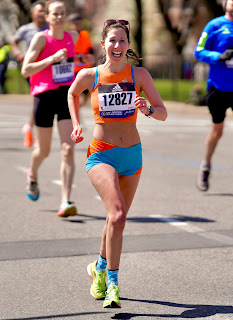 This was the time to dig deep, to stay positive and remind myself I was running the Boston Marathon. I had to run the 2020 Boston on a trail near my house and this was a million times better! I was surrounded by amazing runners and thousands of enthusiastic spectators. I let this sentiment carry me and I had a perma-smile on my face all the way into Boston.
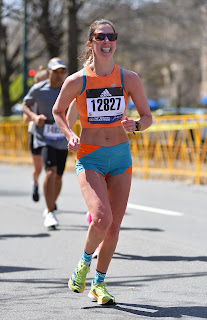 Even though it felt like marathon pace effort, my heart was beating at 10K effort. And I knew this before even looking at the data. So I will be seeing a sports cardiologist later this week. I really hope that nothing is permanently damaged in my heart and that things will eventually go back to normal. I can be patient if I know that normalcy is coming. Because if this is my new-normal, then I can say goodbye to PRs at any distance. Sure, I can hit my training paces, but it won't be possible to go all-out in races.

Training Cycle Recap
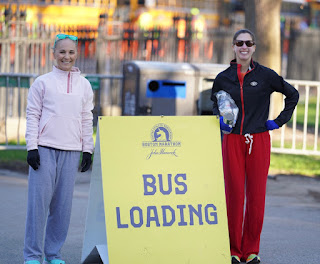 Greg walked with us to the busses, hugged me goodbye and it wasn’t long before we boarded. The bus ride was very bumpy. There were times when I felt like I would be knocked out of my seat. But otherwise it was uneventful and it went by quickly with Deanne as company. We both ate our breakfast. I had a bagel with almond butter and it went down really well. I didn’t have my typical pre-race butterflies. I wasn’t putting any pressure on myself for this race and it was nice to be able to eat a whole bagel without my stomach feeling off.
 The pacing strategy was there to ensure that I didn’t go out too fast. If it felt too fast or if something was hurting, I would certainly back off. I mostly wanted to run a steady effort - faster on the downhills and slower on the uphills. I didn't want to box myself into a very specific pace, but I also needed a plan so I wasn't just winging it. I made sure to use the official mile markers as my reference point, not my Garmin auto lap.
Seeing him was so amazing, as I had not been able to see him during my first two Boston Marathons. During the first one, I missed him entirely. During the second one, it was ridiculously rainy so I told him to hang out in the hotel and meet me shortly after finishing.
Due to having Covid in January (24 days off), and getting injured at the end of March (9 days off) I was only able to consistently train for six weeks: from February 5 to March 24.
My long run progression was as follows, starting with February 11: 10 miles, 14 miles, 17.5 miles, 18 miles, 20 miles, 18 miles, 12 miles (was supposed to be 23), 15 miles.
My weekly mileage gradually climbed up to 70, with everything feeling great— until I hurt my SI joint during a deadlift. Oh the irony of strength training to prevent injuries. . . only to have it cause an injury! In retrospect I should have gotten my lower back checked out sooner and taken a few days off after it happened, but since it was so minor initially, I thought it was just a small niggle that would go away.
Post-Covid Heart Rate
I don’t think I lost much fitness after taking 24 days off for Covid. The first few runs back were hard, but after about 2 weeks I was hitting my normal training paces. My resting heart rate remained elevated for about 80 days, but eventually normalized about three weeks ago. My heart rate while running was consistently 8-10 BPM higher than normal, but the paces felt normal.
 |
| December 16 easy run with avg. HR per mile |
 |
| Feb. 28 easy run with avg. HR per mile |
This is just one example of how my easy run HR was about 8-10 beats per minute higher post covid. Post covid, my easy heart rate is in the low 160s, whereas before covid, it was in the low 150s. I run based on effort, not pace, so my effort level matched the pace post-covid (a 7:00 pace felt like a 7:00 pace), but the heart rate would be much higher post Covid.
The same was true for tempo runs. My heart rate for those post-covid was in the high 170s, and before Covid it was in the high 160s.
I simply brushed this off and thought it would eventually come down. If I didn't train with a heart rate monitor, I would have had no idea that anything changed. I certainly never expected this to impact my marathon because it hadn't impacted my training or how I felt running. I had plenty of energy while running, my breathing felt normal, and nothing seemed off.
Before the Race
I slept about as well as can be expected the night before the race. From about 8:45pm to 1:00am, and then off and on until I was up for good at 4:30. I didn’t have as many pre-race anxiety dreams as I usually do, which was nice.
I prepped my bag to bring to athletes village, got dressed, pinned on my bib, drank a good amount of water, went to the bathroom a few times, and then was off to meet my friend Deanne.
I met Deanne halfway between our hotels and it was a very short walk to the busses. We were in the same corral and it was her first Boston. I had met her at the Rehoboth Beach marathon last winter and we talked about how we would both be running Boston with a similar qualifying time. We were both in Wave 2, corral 5, which had a bus loading time of 7:30 and a start time of 10:25.

Once we arrived in Athlete’s village, we hung out with a few other runners, used the Porta potties many times, applied sunscreen, and adjusted our shoe laces.
After my horrible GI experience in Harrisburg in the fall of 2020, I finally decided to give UCAN another try as my pre-race fuel. I had been using it during training and I have had so many races where UCAN worked well for me. Plus, I switched from the lemon flavor to the orange flavor and it seemed to have a smoother and more airy texture.
I slowly drank my bottle of about 1 and 1/3 packets starting 40 minutes pre-race and continuing until 25 minutes pre-race. It went down very easily and I had no problems whatsoever. I carried my own water bottle so I could avoid crowded water stations in the beginning and ensure that I got enough fluids early in the race. Deanne and I made our way to the start line, and we ditched our outer layers along the way.
Weather
It was about 45 degrees and sunny in Athlete’s village. There was no cloud cover until about 15 miles into the race, at which point it became just partly cloudy. The temperature wasn’t supposed to rise to more than 52 degrees, and it would actually get cooler as we ran into Boston with a 10mph headwind in the last 10K.
It was about 45 degrees and sunny in Athlete’s village. There was no cloud cover until about 15 miles into the race, at which point it became just partly cloudy. The temperature wasn’t supposed to rise to more than 52 degrees, and it would actually get cooler as we ran into Boston with a 10mph headwind in the last 10K.
I think this is probably the best weather Boston has had in nearly 10 years. Of course my ideal is about 10 degrees cooler, but I think this is probably as good as it gets for Boston! So it gets an 8/10 on my race weather scale. A 7:00 start time would have made for a 10 out of 10!
Race Strategy
My plan was to start out at a pace of around 7:45 and gradually speed up if I felt good. I wanted to give myself a shot at a course PR (sub 3:26:54) so I planned to get to the halfway point at 1:41:00. That would put me on pace for a time of 3:22, but I knew I would be slower in the second half, and hopefully I would finish at around 3:25.

Miles 1-6
Deanne and I arrived in our corral and it wasn’t long before our wave was released. I felt like I was running at a very easy pace, as the first mile was mostly downhill and my legs were fresh. These miles were quite crowded so I made sure not to do too much weaving. I typically end up with 26.5 miles on my Garmin at Boston because I don’t run the tangents. I needed any advantage I could get during this race so I tried to run in a straight line unless I absolutely needed to pass someone.
Deanne and I arrived in our corral and it wasn’t long before our wave was released. I felt like I was running at a very easy pace, as the first mile was mostly downhill and my legs were fresh. These miles were quite crowded so I made sure not to do too much weaving. I typically end up with 26.5 miles on my Garmin at Boston because I don’t run the tangents. I needed any advantage I could get during this race so I tried to run in a straight line unless I absolutely needed to pass someone.
My top priority was to enjoy the race and not be too inwardly focused that I missed out on what was happening around me. I did look at my Garmin fairly regularly to ensure that the hills weren’t taking me out too quickly. It was definitely warmer than I would have liked, so I poured an entire cup of water over my head at each water station. Thankfully it wasn’t at all humid! I couldn’t believe that some people were wearing long sleeves. I would have baked!
On my arm, Greg had written 39:00 as my target 5-mile split. I hit that almost exactly— I think I was about 10 seconds ahead. I drank from my water bottle every 15 minutes, and didn’t take any additional fuel until the 1:00 mark, at which point I had 2 honey stinger chews. The UCAN lasts for about 90 minutes, but I wanted to give myself a little extra fuel while my stomach was still easily digesting things.
Mile 1: 7:50
Mile 2: 7:39
Mile 3: 7:41
Mile 4: 7:38
Mile 5: 7:52
Mile 6: 7:32
Mile 2: 7:39
Mile 3: 7:41
Mile 4: 7:38
Mile 5: 7:52
Mile 6: 7:32
Miles 7-11
My official 10K split was 48:10, which is a pace of 7:45. Exactly what I wanted. Soon it would be time to see Greg. He took the Commuter Rail out to Natick and told me he would be positioned shortly before mile marker 8 on my left side. I definitely did not want to miss him so starting at mile 7, I stayed to the far left side of the course and looked at all the spectators. I spotted him before he spotted me and I yelled out his name. Thankfully he saw me in time to shoot some photos!
My official 10K split was 48:10, which is a pace of 7:45. Exactly what I wanted. Soon it would be time to see Greg. He took the Commuter Rail out to Natick and told me he would be positioned shortly before mile marker 8 on my left side. I definitely did not want to miss him so starting at mile 7, I stayed to the far left side of the course and looked at all the spectators. I spotted him before he spotted me and I yelled out his name. Thankfully he saw me in time to shoot some photos!
 |
| Greg's photo at mile 7.8 |
My mile 10 goal was 1:17:30 (7:45 average pace). I was about 25 seconds faster as I passed the mile marker, but I was okay with that, given how great I felt. I figured I might want to hold back slightly until I reached the Newton hills.
I took a Maurten gel at about 1:20 and continued to pour water over my head at each station. It got in my eyes a few times, so I learned that I needed to close them as the water fell down my face. I think I stopped pouring the water on myself somewhere around mile 11 or 12. The sun didn’t feel as strong and I felt more comfortable temperature wise. I was thankful that it didn't get any hotter and I think the warmest miles were actually the first 10.
Overall, these early miles felt amazing. I still felt like I was running my easy pace and I knew I was going to have an amazing day. My legs had no fatigue yet. My SI joint wasn’t bothering me at all. Everything felt loose and smooth and I was completely relaxed.
Mile 7: 7:31
Mile 8: 7:33
Mile 9: 7:34
Mile 10: 7:37
Mile 11: 7:42
Mile 9: 7:34
Mile 10: 7:37
Mile 11: 7:42
Miles 12-16
This was the last stretch of the race before the infamous Newton hills! I was elated that I had made it so far and I knew that even if my SI joint acted up I would at least be able to finish. And really, that was all I wanted: to finish and get the medal. I wasn't at all worrying about my finish time or pace or anything other than the fact that I was in this race and I was going to finish Boston!
This was the last stretch of the race before the infamous Newton hills! I was elated that I had made it so far and I knew that even if my SI joint acted up I would at least be able to finish. And really, that was all I wanted: to finish and get the medal. I wasn't at all worrying about my finish time or pace or anything other than the fact that I was in this race and I was going to finish Boston!
The last time I had run this course, rain was coming down in buckets and wind was pounding me in the face. I was carrying at least 5 extra pounds of weight with my added clothing and wet shoes. It felt amazing to have gorgeous weather and to truly appreciate my surroundings.
I knew that there were probably hundreds of people tracking me. Based on the comments I had received on my Instagram posts as well as direct messages, I definitely felt like I had an "audience" for this race. Even still, every time I crossed a timing mat, I mostly though of Greg, who was waiting eagerly for those splits to come in. I wanted him to know that I was safe and that I was running strong. Every time I crossed a timing mat it was like I got to communicate with him.
My official half marathon split was 1:40:51. Wouldn't it be such a fast half marathon if we could run the first 13.1 miles of this as a half marathon race!? I was 9 seconds ahead of target and I felt like I had plenty of gas left in the tank. I was in great shape. I did notice a mild pain in my left chest, around my heart area, but cramps often come and go during marathons, so I didn't focus on it.
The race didn't start to get hard until the 14th mile, and even at that point, it just felt a little harder. Exactly how it's supposed to feel during a marathon. I still had my chest pain, but there was nothing I could do about it, so I continued to run normally.
There was now a slight headwind but it helped cool me down so I no longer felt too hot. There were enough people to draft off of that if the wind got too bad, I would just tuck behind a pack like I did in 2018. I had my second Maurten gel at 2:00 and it went down easily. At this point, I had ditched my handheld bottle and was drinking from the cups.
Mile 12: 7:35
Mile 13: 7:36
Mile 14: 7:39
Mile 15: 7:49
Mile 16: 7:42
Mile 13: 7:36
Mile 14: 7:39
Mile 15: 7:49
Mile 16: 7:42
Miles 17-21
The Newton hills had arrived! Thankfully, I had not killed my quads on the downhill and my legs were ready to make their way over these 4 monster hills. During the 17th mile, as I was climbing a Newton hill I suddenly felt like I was running at 5K effort. My legs were moving relatively slowly up the hill but that pace felt completely unsustainable from a heart rate perspective. It was as if the effort level suddenly skyrocketed and my heart rate was off the charts high. I needed to walk for a few seconds to bring that heart rate back down.
The Newton hills had arrived! Thankfully, I had not killed my quads on the downhill and my legs were ready to make their way over these 4 monster hills. During the 17th mile, as I was climbing a Newton hill I suddenly felt like I was running at 5K effort. My legs were moving relatively slowly up the hill but that pace felt completely unsustainable from a heart rate perspective. It was as if the effort level suddenly skyrocketed and my heart rate was off the charts high. I needed to walk for a few seconds to bring that heart rate back down.
 |
| Staying Strong at 30K |
And then the next hill came. This one wasn't as much of a struggle as the first and I made my way up it slowly without having to stop. I didn't feel my heart rate surge as much, although I definitely knew it was getting up there. Probably around 10K effort.
And then back down the hill and everything was fine. The next two hills were nearly impossible! I had no idea why this was happening. I had a good amount of energy. My legs were tired but they weren't hurting and they could certainly climb. But yeah, it was like running a 5K or a 1-mile race with how much cardiovascular effort I was putting out.
My official Heartbreak hill split (mile 21) was 9:40 according to the tracking app. That's my SLOWEST Heartbreak Hill of all three Boston Marathons. Slower than in 2016 when I ended up in the medical tent from overheating. I remembered 2016 when I was bonking hard core due to the heat and how much I struggled to get up the hill. This was a totally different kind of struggle. My legs back in 2016 felt like knives were going through them. The pain was unforgettable! But yesterday, my legs were totally cooperative! I just didn't have the cardiovascular strength to get up the hill. "Heartbreak Hill" has a WHOLE new meaning for me now. It almost literally broke my heart!
Mile 17: 8:34
Mile 18: 8:28
Mile 19: 8:20
Mile 20: 8:39
Mile 21: 9:40
Mile 18: 8:28
Mile 19: 8:20
Mile 20: 8:39
Mile 21: 9:40
As this was happening to me, I didn't get discouraged. I just did what I could to get up the hill safely. I am unable to see my heart rate while running, but I do have a wrist HR monitor in my Garmin that is usually pretty accurate so I can look at the data afterwards. Even though I couldn't see my HR, I just knew it was out of control. (I would later find out that my average heart rate for these miles was 175-188, which is what I would expect in a 5K).
Combined with the chest pains, which had mostly subsided by this point, I definitely suspected my heart was not fully recovered from Covid. I had just never put this much strain on it to know its limitations. I could easily get away with 10 miles at marathon pace in workouts and having my heart rate be 10 BPM higher than normal. But after 16 of those suckers and then going uphill. . . NOPE!
Miles 22- Finish
While it was discouraging to have slowed down, I reminded myself that each races has its highs and its lows and just because you go through a difficult stretch during a marathon, it doesn't mean you can't bounce back and run strong again. Just because I had to walk up part of the hills didn't mean I had to continue with walk breaks for the remainder of the race.
While it was discouraging to have slowed down, I reminded myself that each races has its highs and its lows and just because you go through a difficult stretch during a marathon, it doesn't mean you can't bounce back and run strong again. Just because I had to walk up part of the hills didn't mean I had to continue with walk breaks for the remainder of the race.
Now the goal was to finish strong, have fun, keep smiling, and keep the heart rate at a level that was sustainable without having to stop and walk. I figured I could still salvage a BQ (sub-3:40) so I would try my best to do that. My legs had a lot of pep left in them and I had a good amount of energy. I was happy and determined. But if I pushed any harder than around an 8:30 pace, it would start to feel like a 5K again.

When the flags appeared that said "Boston" at mile 24, letting us know we had made it into the city, I got a little choked up. I had made it to Boston. Safely and without my SI joint injury stopping me. I was so grateful. I had so much to be thankful for that the slow down didn't even faze me. I chalked it up to my heart not being 100% post covid and I would deal with that later.
I knew to expect Greg at around mile marker 25 on my right. I made sure to stay to the right of the course and I looked at all the spectators, searching for his bright yellow jacket and white hat. I wanted him to see me looking strong and having the time of my life. I was so happy when I finally got to him! I knew I was going to make it and he knew I was going to make it. And it wouldn't be long until we could celebrate my finish together!
 |
| Less than a mile to go |
As I made the final turn onto Boylston I had so much energy. The adrenaline was insane and I felt like I could have run forever! This was the grand finale that dreams are made of. I later found out that I ran my fastest ever mile 25 and mile 26! So even though my time was slower than 2018, I was faster in the final miles. Here is a photo of me running down Boylston:
 |
| Pure Joy! |
Mile 22: 8:32
Mile 23: 8:46
Mile 24: 8:41
Mile 25: 8:36
Mile 26: 8:47
Final 0.42: 7:49 pace
Mile 24: 8:41
Mile 25: 8:36
Mile 26: 8:47
Final 0.42: 7:49 pace
The Finish
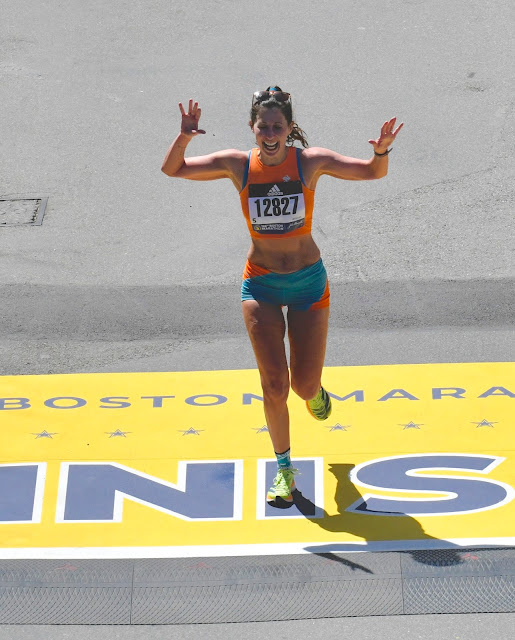
Speaking of photos, one of my goals for this race was to finally get a good finish line photo. In previous years, I was blocked by so many other runners that you can't get a good view of me. I was also wearing hats in the previous two races so the aerial shots didn't work great. This year, since I was not on the verge of hypothermia or heat exhaustion, I had the mental capacity to strategically place myself when crossing:
 |
| I got my finish line photo! |
I think more will be posted soon, and when they are I will add them to this blog.
My official time was 3:33:04. This is a BQ by nearly 7 minutes! I didn't get a course PR but at least I finished with a very respectful time. Especially when you consider that I was only able to train for six weeks! It's also crazy to think that I ran 6 minutes faster in a torrential downpour with a 25mph headwind back in 2018. It gives me even more respect for my previous self!
After crossing the finish line I noticed that I didn't need to vomit. This is my first marathon in about 5 years where I haven't vomitted or dry heaved at the end. I attribute it to being relaxed and not pushing to my max. I had to keep that heart rate under control.
I walked through the finish line area, got my medal and my heat sheet and met up with Greg at our pre-determined meeting spot. He had got there before me, even though he walked all the way from mile 25.2 and I ran. That's because my walk through the finish area was very, very slow. I also stopped to talk to a few people along the way. I was elated when I finally met up with him and together we walked about half a mile back to the hotel.
On the way back to the hotel, I told Greg that the limiting factor wasn't my SI joint or my hip or my foot. . . it was my heart rate. I told him about the chest pains around my heart and the feeling of running 5K effort when going up hill.
At the hotel, I immediately uploaded my data to my phone and looked at my heart rate. Sure enough, it was elevated throughout the entire race. I averaged a heart rate of 171. During the Newton hills it peaked at 198, and it even averaged 188 for one of the miles. Usually I only see that kind of heart rate when I'm racing a 5K in the heat.
I called my coach and she suggested that I look at heart rate data from my previous marathons. Sure enough, I was consistently averaging 163-164 for those (at a significantly faster pace). My half marathons typically average around 169.
By mile 6 of this race I was already averaging a 173 heart rate per mile
Mile 6: 173
Mile 7: 173
Mile 8: 178
Mile 9: 174
Mile 10: 174
Mile 11: 175
Mile 12: 175
Mile 13: 174
Mile 14: 176
Mile 15: 188
Mile 16: 178
When I ran my Turkey Trot PR back in November, my mile-by-mile HR was 170, 181, 182, 173, 174, 173, 173. And that race averaged a pace of 6:35.
Mile 7: 173
Mile 8: 178
Mile 9: 174
Mile 10: 174
Mile 11: 175
Mile 12: 175
Mile 13: 174
Mile 14: 176
Mile 15: 188
Mile 16: 178
When I ran my Turkey Trot PR back in November, my mile-by-mile HR was 170, 181, 182, 173, 174, 173, 173. And that race averaged a pace of 6:35.

Final Thoughts and Key Takeaways
I did it. I ran Boston! After all the obstacles I faced this cycle, I made it to the start line healthy and I powered through 26.2 miles of joy and celebration. I earned my 4th Boston medal. I got another Spike unicorn. I have another jacket. Another bib to display. My fastest ever run down Boylston! My best finish line photos! There's so much to celebrate and to be thankful for. A 3:33:04 in Boston is a huge achievement and I am so proud of it!
I did it. I ran Boston! After all the obstacles I faced this cycle, I made it to the start line healthy and I powered through 26.2 miles of joy and celebration. I earned my 4th Boston medal. I got another Spike unicorn. I have another jacket. Another bib to display. My fastest ever run down Boylston! My best finish line photos! There's so much to celebrate and to be thankful for. A 3:33:04 in Boston is a huge achievement and I am so proud of it!
My fueling plan worked, I had no GI distress. My legs didn't give out on me and I am less sore than I was at my previous two Bostons. Did I push to my max during the final 10K? No. I did what I could safely sustain. Heart stuff can be serious, but I am not going to freak out yet. I am going to assume that my heart just needs time to heal and all will go back to normal eventually unless my doctor tells me otherwise. I haven't had any heart symptoms since the race.
Ranking:
Overall 11260/24819
In Gender 2962/10563 (Female)
In Division 499/1634 (F40-44 Age Group)
Top 500 Age Group is really good for Boston! This was also my first Boston Marathon as a 40+ year old. I was 39 back in 2018. I'm also in the top half of all runners, which is nice to see. My bib number was 12827 and I placed 11260, and I always love beating my bib number.
I will either return to Boston in 2024 or 2025. Greg will be 45 in 2025 which means he gets 10 extra minutes onto his qualifying time (3:20 vs. 3:10). So if he qualifies, I will wait to run it in 2025. If not, I will likely go back in 2024. Either way, I am definitely not done with Boston! More to come.


