Showing posts with label recovery. Show all posts

Saturday, March 18, 2023

Spring Break

I have not updated my blog in over a month! That is a long time for me to go without blogging. That's because my running life has been pretty uneventful. I haven't run any races and I am not training for anything at the moment. I'm fully recovered from Covid and I am not injured; but I have decided it would be a good idea to take an "off" season. 

Even though I only ran one marathon, I trained for two marathons, starting in August of last year. This meant way more long runs than I ever want to do again in a 5-month period! I was only doing 1-2 hard workouts a week and the mileage was low for me. But the long runs gave me a bit of mental burn out. Maybe if I had been running my normal 65-75 mile weeks, the long runs would have felt shorter because they would have been a smaller percentage of overall volume. Because I was averaging 55-65 miles a week, the 20s really started to take their toll. Toward the end of the cycle I was starting to dread them and I usually look forward to my long runs!

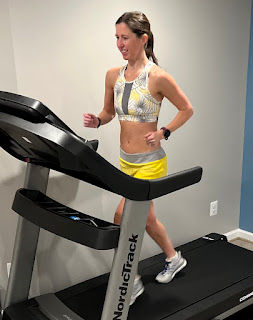
Strength training in my home gym
I had been registered for the One City Half Marathon the first weekend in March, but I didn't have enough time to train given marathon recovery followed by Covid. I am sure I could have finished the race, but I didn't want to do it without proper training. Of course the weather that day was perfect! 

After One City, I didn't have anything on the schedule so I kept it that way and decided to prioritize strength training. Instead of doing 1-2 sessions a week, I am now doing 3. One of those sessions is an hour-long workout with my strength coach Angela, and the other two are about 25 minutes each on my own. I think I have reached the limit of how much running I am able to do in a training cycle, so the gains I make in the fall will come from being stronger. 

I had planned on taking up swimming again to change things up, but it's difficult to motivate to drive to the pool, change, swim, shower, change, and drive back. If it weren't so logistically involved, I would do it every day. But now that I have a gym in my basement, it's so much easier to work out there. 

This spring break has been nice. I've been keeping most of my runs easy, throwing in a few strides here and there just so my legs remember how to turn over quickly. It's a good mental break and it's freed me up to focus on other areas of my life that I typically de-prioritize. 

The good thing about having had so many bouts of mono is that I know I can quickly ramp up training and get into race shape. I only need about 6-8 weeks to get myself to a good place and a few more to be in "race shape". 

Right now the plan is to focus on strength training, mobility and stability. And then I will begin training for my annual July 4th 5K. I might do a few tune-up 5Ks before then. I suspect that this break from racing will leave me super hungry to get out there and grind when the time comes. 

In the meantime, I will continue to blog. I have a few ideas of posts that I have been meaning to write!

Sunday, February 6, 2022

Covid Recovery - Slow but Steady

I hope I am not jinxing myself by saying this, but I believe myself to be 100% recovered with no lingering symptoms. In my previous post, I said that this would either be a "normal" recovery or it would turn into my mono-like illness, taking months to recover from. 

In retrospect, it seems like it has taken me slightly longer to recover than the average person, but not abnormally long. Here's a recap:

Days 1-2: Mild sore throat
I noticed that my throat was slightly scratchy. It was more of an annoyance than anything else; I had no other symptoms and was fully energized. Thankfully, I didn't run during this time because I was on vacation and was planning to take a few rest days anyway. I took the required Covid test to fly home from Mexico and it was negative.

Days 3-5: Severe sore throat, loss of voice
These were the worst days. I was moderately fatigued but I couldn't eat whole foods and I couldn't speak. I was continually spraying throat-numbing solution down my throat and using NyQuill to sleep. My at-home Covid test was negative on day 3, but positive on day 5.

Days 6-12: Body aches, coughing fits, skin rash, fatigue
My sore throat lessened in severity but I had coughing fits about 8-10 times per day and it kept me up at night. I had tiny bumps all over my back, butt and stomach, and a few on my legs. Not loads of them; maybe 20 total. I started to feel more energized by day 11, so I walked on the treadmill on days 11 and 12.

Days 13-17: Lingering fatigue, body aches
It turns out that the treadmill walk was too much and I woke up the next day feeling totally wasted. I did, however, test negative for Covid on my at-home test. At this point I think I was rid of the virus, but I was now suffering from post-viral illness, which felt similar to my mono episodes. The big difference between this and my mono episodes is that I was never tired in the sleepy sense. I didn't nap. The fatigue was more of a bodily fatigue and not a head fatigue. I also did not experience dizziness like I had with my mono.

I decided not to engage in any physical activity at all during these 5 days. I just rested. On day 17, I decided to take one of my Turmeric supplements. I had read an article about post-viral fatigue and it said that some researchers believed it to be caused by brain inflammation. Turmeric is a natural anti-inflammatory so I figured it was worth a shot.

Days 18-22: Major improvement
The day after I took the turmeric I noticed a major improvement. If I was at 65% on day 17, I was at 85% on day 18. I felt almost normal the very next day. I decided I could go ahead and resume walking, but very slowly and only for 15 minutes. 

By this point, I had only slightly noticeable throat congestion and the sore throat was totally gone. I didn't have body aches any more. I continued with the turmeric plus the other vitamin supplement I had been taking all along (Zinc, D3, C + lots of other herbs). 

Every day from 18-22 I felt better and better, with my legs feeling stronger as I walked. Previously, they had felt like jello. 

Day 23-Today
By day 23 I was 100% symptom-free and feeling like my normal self. No lingering fatigue. No weakness. No throat congestion. I continued my walking regimen and got up to 2 miles walking before I attempted to run. My first run back was a run-walk on the treadmill because it was pouring rain outside. I did 6 x (3:00 walk, 2:00 run). And I kept the runs very easy. 

Everything felt great during the run and after the run. So I continued to progress my workouts, shortening the walk breaks and increasing the overall duration of each session. My most recent run/walk (today) was 8 x 1:00 walk, 4:00 run. This is 32 minutes of running. I didn't feel like I needed the walk breaks, but I kept them in any way as a chance to "check in" with myself to make sure everything felt normal after each run. 

I can't stress enough the importance of walking multiple times before attempting to run, and waiting to be  100% symptom free. I felt 100% symptom free for about 4 days before I started to run, and when I did run, it was a run/walk. 

While there is a protocol for returning to run post-Covid, everyone is unique and it also depends on how long you were sick and how severe the illness was. Because I have so much experience with illness, I know my body pretty well and I can tell when I am ready to walk and when I am ready to run. My rule is to always wait a few extra days after feeling ready! I probably could have run on day 22, but I waited an extra 5 days to be absolutely sure. I would much rather have a slow and steady comeback instead of a rollercoaster of ups and downs from doing too much too soon. 

Looking Ahead
Overall, this illness took about a month of training from me, plus the 2-3 weeks it will take to get back to where I was. With the Boston Marathon coming up in the middle of April, I certainly have my work cut out for me. Thankfully I was in pretty good shape before I got sick and my body adapts to workouts relatively quickly. I don't plan on doing any hard running for another week; I first need to wean myself off of walk breaks and then increase the duration of my runs. 

I'm not at all worried; I know I will be able to finish the marathon and I wasn't planning on trying to run a PR anyway. My original goal was to run a course PR and I think that's still possible, but I will re-assess as the race gets closer. 

Sunday, July 4, 2021

Large races are back, and so am I!

774 people came out for the Reston Firecracker 5K this morning. That's by far the largest race we've had locally since last March! It was a festive morning with beautiful weather, and I was extremely grateful that I was able to keep up with the tradition.

I've run this race every year since it started in 2010 with three exceptions: 2013 (injury), 2016 (mono), 2018 (mono). I even ran the virtual Firecracker last summer! It's hot and hilly, but a lot of runners come out for it so it's always fun! Thankfully I am far enough into my injury recovery to be able to run a 5K.

Before The Race
I had no idea what to expect out of this race. I knew that I was not going to run race effort. So far, the

longest I have run without stopping for a walk break is 15 minutes. I have not run faster than an 8:00 pace since the marathon in March. I thought it would be a good idea to run it at a medium effort, increasing to a hard effort at the end if I felt good. And definitely no looking at the Garmin! The whole thing would be run based on feel.

Two hours before the race I had half a serving of the Maurten Drink Mix 160 to top off my carbs and electrolytes. I didn't eat anything. I foam rolled and used a massage ball on my glutes, quads and hamstrings. I made sure everything was really loose. 

Greg and I arrived at the race shortly after 7:00. We already had gotten our bibs so there wasn't much to do other than use the bathrooms and walk around. At 7:40, I had a caffeinated Maurten gel and we started our warm up. I also did some drills and glute activation exercises. We ran into Hannah, Alex and their daughter Luna and it was nice to see friendly faces! The warm up was only 0.75 miles. After all, it would be a new milestone just to run 3.1 miles nonstop, so I didn't want to wear myself out during the warm up!

It was around 67 degrees with about 25% cloud cover and a light breeze. The low humidity made it feel heavenly and I was actually chilly before the race started. This was probably the nicest weather this race has ever had, and of course I was not in shape to really race it! 

I was thinking I would probably run somewhere in the 25:00's. If I was having a good day, then the 24:00's were possible. I've been averaging around 8:30 for my training runs so with a little extra effort, I thought I should be able to get under that.

Mile 1
Greg and I planned to run the whole thing together, and I would set the pace. We started farther back in the

Photo by Cheryl Young
corral than we should have, so there was a lot of weaving in the first mile. I knew I needed to take it easy during the first mile, so I started out at what felt like marathon pace effort-- something I could sustain for a very long time. As we progressed through the mile things got a little harder, but totally manageable. 

Mile 2
Mile 2 is mostly downhill. It's always the fastest mile of the race by far. I decided to coast along and let gravity do its thing. The effort level was a little harder than marathon pace as I gained confidence that I could push harder and still be ok. We passed many runners and nobody passed us. I made sure to stay focused on my form, to run with my glutes and to drive the knee forward.

Mile 3
This mile is always killer. From about 2.5 until the finish, it's one big long up hill! I had to really work to get up the hill without slowing down. And as we closed in on the final uphill stretch I gunned it and sprinted to the finish. It was so fun to be chasing down a finish line in a large race setting. Oh how I have missed that feeling!

I was shocked when I looked at the clock and I saw that the first two numbers were 22.  WHAT?! I had no idea we were going that fast. I totally expected to see something in the 24s!

When I finally looked at my Garmin I saw I ran a time of 22:37, which matched the official results. Good enough for 5th place in my age group, and I wasn't even racing at full effort! My splits were 7:15, 7:00, 7:06, and a pace of 6:51 for the last 0.18 according to my Garmin. I was really surprised, especially since I could have raced that much harder than I did. That felt like marathon pace for the first mile and then a tempo run for two miles.

We didn't do a cool down, but we did walk around the race for a little while and socialized with friends. We then had brunch with Cheryl who had been there taking runner photos. I have her to thank for the photos in this blog.

Final Thoughts and Key Takeaways
This was a really good run for me. And it's totally shocking that I could run that fast when I haven't run anything faster than 8:00 since March. Even more shocking that I did it without a ton of effort. It definitely wasn't easy, but it felt totally controlled and manageable.

I don't have any speed work on the schedule for the next two weeks and I am totally fine with that. July is all about building my base back up so I can begin marathon training by mid-August. The woman who has been my strength training coach for the past year is also now my running coach! It just made sense to have one person managing my running and strength. My previous coach was amazing and I advanced so much under him, so it was not an easy decision. But after 7 years, I figured it might be nice to change things up a bit and experiment with a different approach. She also coaches under Greg McMillan so I will remain a McMillan runner!

I'm very thankful that I had a pain-free run and that I continue to progress. This is all very encouraging.


Monday, June 28, 2021

Focusing on Form

I've now been running for 3 weeks after taking 8 weeks off for my Osteitis Pubis and torn adductor. As I said in my last post, I am using the run-walk approach to gradually get back into my normal routine. So far my longest run has been 5 x (9 minutes running, 90 seconds walking). That adds up to 45 minutes of running total.

I'm probably at a point where I can start to get rid of the walk breaks but I like them because 1) it's crazy hot and humid and I need my heart rate to come down and 2) I'm 100% focused on my form and stride and I need a mental break from that. It's also good to check in to make sure everything is feeling good and nothing is hurting. I would hate to finish a run and realize I made the injury worse but didn't get that feedback immediately.

I went to the doctor last week and she was pleasantly surprised at how quickly I was recovering. She gave me and exam and tested my strength as was impressed that I had made such progress. It wasn't a guarantee that this adductor tendon would heal on its own, but thankfully it's most of the way there and I won't need surgery or any other kind of procedures. Just the dry needling which I stopped about a month ago.

A note to subscribers
Before I get into the meat of this blog, I have an update for my subscribers. After this post, Feedburner is going away and I am using a new email system called Feedblitz. You might get an email asking you to confirm your subscription. So if you do, please confirm it so you can continue receiving emails. If you are NOT a subscriber and want to subscribe via email, there is a form on the right column of the desktop version, or you can subscribe at this link. (I know it looks a little sketchy, as I designed it to fit on the sidebar of the blog desktop version. Just click subscribe, enter your email and click subscribe again.) If you already get emails, no need to fill out the form again.

Issues with my running form
Back to the topic of this blog. Fixing my stride will not only prevent this injury from coming back, but it will make me a stronger and more efficient runner. 

I have always been a "shuffle runner". I wouldn't pick my feet very high off the ground and drive forward with the knee. My stride was short, partially due to limited range of motion in my ankle. In order to offset
Drills before running
this and still run fast (like a 5:52 mile) I adapted by having a very high cadence. Most runs would average 200 steps per minute and speed work would sometimes average 210. My feet would stay super close to the ground and move very quickly. Like shuffling!

Another form issue was that when I landed on my left foot, my right hip would drop down, making the pelvis unstable and uneven. This is a common issue with runners and can lead to injuries. It indicates instability and lack of glute activation. I also had this issue on the other side, but it was not nearly as pronounced. It makes sense that I tore the left adductor because I wasn't activating the left glute when I landing -- the right hip was dropping.

I have known about this hip drop issue for over a year now and have been working on it with my strength training coach. I have strong glutes! The problem is that my body doesn't naturally tap into that strength when running. It prefers to use the adductors. If I were able to access that power, I would be a more efficient (faster) runner and be protected from re-injuring my pubic bone.

Changing movement patterns
Working with my Osteitis Pubis specialist in Australia, live video feedback or mirror feedback has been essential. The focus is on doing all the PT exercises 100% correctly. It's not about doing them to get strong (although some of them build strength). It's about teaching my body to have a stable pelvis when put under different types of stress. There are literally over 100 exercises. I am not exaggerating. When I say "literally" I don't mean it like a millennial. I mean literally over 100 exercises. It would be overwhelming to do them every day, so the point is to progress through them one step at a time adding more stress and complexity while keeping a stable center of gravity and a pelvis that is controlled.

There is a huge focus on deadlifts, bird dogs, downward dogs, and side planks. There are many variations of each that challenge pelvic stability in different ways. Being able to see myself on video or in the mirror has enabled me to ensure I am doing the movements correctly, which ultimately translate to running. 

Greg has been recording videos of my running so that I can analyze my stride afterwards. He records some of them in slow motion so I can really see where I need to pick the legs up higher or keep the pelvis more stable. Drills have also been important in reinforcing the correct movement patterns, provided that I am doing the drills correctly. 

Here is what my hip drop looked like last summer:


Here is what it looked like yesterday:


And here is a back view, which is much more noticeable, taken last summer:


This was taken on Saturday - notice the difference:


My knees still come together, but that's just my anatomy. When my feet are pointed straight ahead, my knees go in. When my knees are straight ahead, my feet turn outwards. My PT said that was fine and you can't fix your anatomy! The important thing here is that the line of the top of my shorts is straight across rather than slanted down, like in the green shorts from the previous photo.

What I think about
As I said earlier, I need the walk breaks because focusing so much on my form is mentally exhausting. There are only so many mental cues you can give yourself at a time. Here are a few of them:
  • Feel the glutes working
  • Engage the core to keep stable
  • Keep the spine elongated
  • Shoulder blades down
  • Lean forward from the ankles
  • Drive forward with the knee
  • Use gravity to fall forward
  • Most of the weight in the forefoot
  • Stable foot "tripod" when landing
  • Remember deadlift form
I hope this way of running becomes automatic. I honestly have trouble running slowly when I do this. It's easier to open up the stride when you are running fast. This normally wouldn't be a problem but I don't have the cardio fitness to support the faster paces, and it's crazy hot and humid! My heart rate has been averaging in the 170s for the run segments because I am out of shape and it's hot. My paces range from 8:10-8:30 once I get going. That used to be my easy pace but it's not my easy pace right now, and it's definitely not my easy pace in the heat. So hopefully I will get the hang of it and be able to run in the 9:00's so I won't be dying in the heat. 

I'm on track with my plan to build a base in July and start marathon training in August for Richmond!


Saturday, June 12, 2021

Back on the Roads!

After 8 full weeks of zero running, I have started back up again. Very gradually!

I was not exactly sure when it would be safe to return. My physical therapist cleared me to run after 7 weeks, but I felt like I needed an extra week. I still felt the injury with certain movements and I wanted more confidence that I wouldn't hurt myself. Meanwhile, the Osteitis Pubis specialist I am working with in Australia doesn't advise running until stage 8 of his program- which I won't reach for another few weeks.

The physical therapist tested my strength and was confident that I was far enough along in my recovery

that running would be ok. My adductors, glutes, abs, hamstrings -- all have a healthy amount of strength to support running. He gave me a return to running program that seemed too aggressive so I decided to use a more conservative program from my strength coach, Angela. I'll use her program at least initially, and if I feel like I can progress faster then I will switch back to the PT's plan. 

Monday, June 7
For my first "run" back, I did 6 sets of 0:30 running, 4:30 walking. Essentially this was a walk, with six 30-second jogs thrown in. This was discouraging. I felt the injury more than I expected to. I tried focusing on my form and just being really purposeful about my movements but I still felt irritation in the pubic bone area. I did have some hope, however, in that a few of the reps felt decent. I would say about half them felt pretty good and the other half did not.

Did I do too much too soon? As soon as I stopped the running portions, walking felt 100% pain free. And I didn't have any hints of the injury for the rest of the day or the next day. What a relief. This means that my 3 total minutes of jogging didn't make things worse and I could proceed with the plan,

Wednesday, June 9
Building on Monday's session, this time the 5-minute blocks were split as 1-minute run, 4-minute walk. Twice as much running! I was a little nervous heading into this but I was pleasantly surprised that I had very little pain. I felt WAY better than I did on Monday! I was very encouraged by this. So what made the difference between Monday and Wednesday? I think it's a combination of:

  • I focused more on my posture and pulling the shoulder blades down. This was feedback I got from the Australian specialist when doing a Bird-Dog exercise during our Tuesday session.
  • My body needed to get the message "Hey, we're running again, and it's okay" and shake off some of the cobwebs
  • My body needed to recover from a run and realize "that didn't cause an injury"
I've learned that the mind-body connection is REALLY important in recovering from an injury. The brain becomes used to feeling pain with certain activities so you need to train it to not feel pain once you can do those activities properly.

Friday, June 11
No injury flare ups or pain all day Wednesday or Thursday, so I advanced on Friday to 1:30 run/3:30 walk. This was also encouraging although not perfect. I would say that maybe 5-10% of my steps triggered a mild pain sensation around the pubic bone, but the rest were fine. Some of the reps felt much better than others. Once again, I really focused on my form. Several key items:
  • Fall forward as you run - let gravity help
  • Keep a straight spine with the shoulder blades down
  • When landing, ensure that the toes are spreading to form a stable platform
  • When pushing off, observe the firing of the glutes
  • Breathe through the core to help engage the core
I am encouraged by all of this and I continue to work with the PT, the Australian specialist, and my strength coach. I think my biggest issue is stability, which can be improved by glute activation. My lack of stability causes my pelvis to move too much, which is not good. My PT also discovered that I have extremely tight glutes and I fail his strength tests before massaging them out with a lacrosse ball. After the massage, my glutes start to work. So I should be using my massage ball on my glutes before each run.

I continue to swim 3-4 times a week, and I have gotten my swims up to one mile. Last week I swam 4 miles! I joined an outdoor pool so even once I am back to running full time, I plan to incorporate swimming. We also bought a rowing machine which is also great for cross training.

Long term plans
In an ideal world, the next six months will look like this:
  • June: Run/Walk, be able to run continuously for 40 minutes by the end of the month
  • July: Build a mileage base, introduce strides and some introductory faster workouts
  • August: Begin training for the Richmond Marathon, include long runs and tempos, run a 5K
  • September - October: Richmond Marathon Training, run a 5K and a longer distance
  • November: Richmond Marathon
My physical therapist is confident I can progress at this rate and so am I. As for the Boston Marathon, I plan to use my Two Rivers Marathon time to qualify for the April 2022 race. I have a cushion of over 20 minutes, so I'm confident that I will be accepted!

Monday, May 24, 2021

Recovery from Osteitis Pubis

My recovery from this Osteitis Pubis injury has been more involved than any other injury I've ever had. To recap, I have a partially torn adductor with "moderately severe" Osteitis Pubis according to my MRI from April 25. You can read my previous post for all the details. 

Physical Therapy
I started seeing a pelvic floor physical therapist in the middle of April, twice per week. Each time I go she gives me a new set of exercises to do. She started with simple, easy exercises such as the Kegel (pelvic floor contraction) and abdominal squeezes. I don't know the official term, but it's basically just sucking in on the lower abs. Over time she has given me more strengthening exercises like squats, adductor raises, clams, and more. 

In terms of treatment she's done dry needling which hurt so, so much, as well as blood flow restriction therapy. Blood flow restriction therapy wraps a tight band around your quad that feels like a blood pressure machine. It squeezes just like a blood pressure machine while you perform squats to help make greater strength gains with a lighter load. The dry needling, painful as it is, has really helped me feel more normal when walking around. 

I do the exercises nearly every day, in combination with the other items below. These exercises are designed to build strength in the areas around the injury so that when I start running again, everything will be strong enough. 

Strength Training
While the physical therapy exercises are designed to rehab anyone with this injury, I am working with the same strength coach I've had for over a year on making sure I maintain my overall body strength during this time. I would be doing this even if I didn't have an injury, and she has tailored the program to focus on the areas that need the most help: deep core, glutes, adductors. These exercises are more challenging than the PT exercises, involving weights and resistance.

The OP Clinic
I was referred to the OP Clinic in Australia by a friend who also had this injury. He does virtual sessions over Skype. He specializes in OP and the purpose of his program is to rewire your mechanics and movement patterns so that you don't overload your pubic bone. The sessions are a very small part of the program. He has given me a self-guided program with "homework" exercises that I learn through videos. I send the videos to him as soon as I am able to complete the exercises properly and he reviews them and lets me know if my form is correct or where I need to improve.

The program starts with basic core breathing, establishing a strong center of gravity, and having correct form for basic exercises like the deadlift. It's an extremely intense program and so far I've spent over an hour each day watching all the videos and going through each exercise. Stability is the key focus, and in order to be stable you have to engage your core and glutes. It's challenging to upload videos to this blogging platform but if you follow me on Instagram, I post videos to my story all the time. 

Right now I'm focused on learning how to do the perfect deadlift. This involves breathing properly, having the right center of gravity, engaging the glutes, moving slowly, keeping a straight back (not hunched or arched), and feeling the "fascial tension" as I slowly perform the movement. I am doing deadlifts with bands and on my forefeet to ensure I am not rocking back into my heels. 

The OP Clinic is a 10-stage program and by the end of it, I should be able to run as much as I did pre-injury. Because my mechanics will have changed, I will no longer be overloading my adductors. There is no timeline for how long this will take. I can get through the program at whatever pace I am able to. The program isn't necessarily designed to heal; the body does that on its own. It's designed to help patients stop overloading their adductors and pubic bone. Here's how I see all of these working together:

  • Physical Therapy: Helps the injury heal with different therapies and exercises
  • Strength Training: Ensures I have the strength needed to support an intense training load
  • OP Clinic: Overhaul of my running mechanics so I don't keep injuring the area
Cardio
In addition to the above, of course I want to maintain some level cardiovascular fitness. I started swimming two weeks ago, once I felt like it would be safe to kick my legs. It turns out I don't have a great freestyle kick to begin with so swimming is 100% fine. Due to Covid, I have to reserve a lane a few weeks in advance so planning has been tricky. 

Swimming
I've been swimming 3-4 times per week. I swim freestyle, and that's my only stroke! I know how to do the others but the breast stroke kick wouldn't be good for my injury and I'm only good for about two laps of butterfly before I fatigue. My typical swim is 20-25 laps, lasting about 30-40 minutes.Yesterday I introduced pool running with the belt. I did 5 minutes yesterday and 10 minutes today after my swim. My plan is to very gradually ramp up the pool running because I do not want to strain the adductors. 

I enjoy swimming, but it's a high maintenance activity. I have to reserve my lane in advance due to Covid capacity restrictions at the pool. Once I get there I have to lather up with pre-swim lotion so that my skin doesn't get irritated. And then get all situated with my swim cap, googles, and waterproof mp3 player. And when I am done, I have to shower there to immediately remove the chlorine from my hair and skin. I think I spend more time driving to and from the pool + getting ready and showering than I actually do with the swim. 

Walking
For the first few weeks I was hobbling around and not properly balanced. I could feel the injury with each step even though it wasn't painful. About a week ago I got to a point where I could walk and not feel the injury! Huge progress. I have been taking 2-3 mile walks and loving it. The weather has been gorgeous and Greg and I even went to Burke Lake park one afternoon to walk. We also took a few days off work to go to Annapolis and I did a lot of walking around there. All pain free!

I'm averaging about 60-90 minutes of strength/PT each day and then another 40-60 minutes of cardio (walking and/or swimming). It's more time consuming than running but it's what I need to do to get back out there again while preserving my sanity!


Monday, April 5, 2021

Marathon recovery and chess tournament preparation

I spent last week recovering from the Two Rivers marathon. I experienced a sleep nirvana like no other. For four nights in a row, I slept straight through the night, with loads of deep sleep (according to my FitBit), and for 1-2 hours longer than usual. I would have expected that with no running, I wouldn't need so much sleep, but it was like my body knew it was recovering from a major event and the sleep was phenomenal. FitBit even gives you a sleep score, and one night I got a 90, which is the highest I have ever seen, followed by a 91! This tells me that I really did leave it all out there on the course and that perhaps I didn't have enough rest going into the race. 

Mentally, I feel much better about the race. I wrote my blog when I was still processing all of my emotions. Of course, that is the main reason I keep a running blog - for reflection and closure on my race experiences so I can move on in a productive manner. My main takeaway is that I ran a solid race on a tough course without having as much of a taper as I needed, given the extended training cycle. I'm proud of my execution and my BQ cushion of over 20 minutes. 

Also, running is just one aspect of my life; not my whole life. When I was training at 75+ miles per week it felt like my whole life because I didn't have the time of energy for much else. But getting 10+ hours back last week with no running made me realize just how much of a commitment I made to that training cycle. Unlike with past marathons, I didn't jump to sign up for future races. I only have one race on the calendar (a half marathon in May) and I give it a 50/50 chance of getting canceled. So everything is up in the air with my future race plans, which is a first for me!

Additionally, I have a mild injury, which I am fairly certain stems from the bike accident I had in 2019. While vacationing in Norway, my tire got caught in a rail track, stopped the bike, and I fell onto the bike with my pelvis hitting the bar with a massive amount of force. The area never completely recovered. It was about 95% there and then I ran CIM 4 months after the accident and that aggravated it again. When I started strength training in May 2020, I started feeling it again with lower abdominal exercises. And I noticed that engaging my lower abdomen in any way made the area feel a little sore.

It was extremely mild so I didn't do anything about it. I trained for Harrisburg with no issues. But as I ramped up for Two Rivers in February, I noticed that the pelvic area would get tender from running. During the marathon, it was a little achy, but nothing major enough to even mention in my race report. When I finished the marathon, I did experience some nasty pain throughout the groin and pelvic region, which continued for the rest of the day.

Ever since the marathon, it's been a little achy when I have to use my lower abdominal muscles or when I move my legs in a certain way. I had an X-ray done today and was diagnosed with mild inflammation of the pubic synthesis, which means I need to cut back on running for four weeks, and I am totally fine with that.

Now onto the exciting stuff: I competed in a chess tournament last weekend!

Background
I started playing chess when I was six. I loved it so much that I asked for an electronic chess set for my 7th birthday and I played that thing all the time. It wasn't long before I could beat my dad. Then came the teenage and college years, followed by my 20s when I rarely played. I beat my boss at a job I had in my early 20s and he was just as competitive as me, and he didn't like that I beat him. And so as a general rule of thumb, I learned never to play my boss in chess. It's more important for your boss to like you and respect you for the work you do on the job, not because you can outdo him or her in some other game.

Chess on vacation in 2018
Fast forward to around 2011, the year after Greg and I got married. We took a trip to visit his parents who lived in Albuquerque, NM at the time. His father had a chess set and the three of us played many games because there really wasn't much else to do! This chess binge got Greg, his father, and me all "into" chess again. We set up accounts on chess.com and continued playing each other long after the visit to New Mexico. And then my father also joined chess.com and the four of us would play each other frequently. And then I started playing random people on chess.com.

But back then, I didn't have the mental toughness that I learned through running and through working with a sports psychologist. I would be extremely hard on myself for making a mistake. On chess.com you have a rating and when you lose, your rating goes down. And at some point in 2012 I think, I lost a few games in a row, became super frustrated, and stopped playing on chess.com. Greg and I also stopped playing on the board. We would only play on vacation when the place we were staying had a board. Greg got his rating so high that he stopped playing because he didn't want it to get any lower. 

A New Beginning
Fast forward to January 2020, when I saw a Facebook post from Michael Wardian, a professional ultra runner who lives in the DC area. He posted that he was getting into chess and that he was playing games on chess.com. I thought it would be super cool to play him, so I re-installed the app on my phone, logged into an account I hadn't been in for eight years, and challenged him. There are different types of games you can play on Chess.com with regards to how much time you get to make a move, and we played where you have an entire day to make a move. That way you don't have to be on the app at the same time. 

My favorite checkmate ever: two equines!
Whenever one game ended, we would start another one so that we always had a game going. I started to explore all the features of the chess.com app and I loved doing the puzzles. I even started playing "blitz"games that only gave each players 5 minutes total to finish the game. You win by either checkmating your opponent or having their clock run out faster than yours. I was absolutely horrible at this because it requires you to think fast under pressure.

Before I knew it, I had caught the chess bug again and upgraded my Chess.com subscription so I could play more puzzles, analyze more games, and take more lessons. And Greg got more into it as well. He started doing the puzzles and we started playing more games against each other. He also started watching chess videos on YouTube, which he used to watch years ago, but of course now there are like 100 times more of them available and they are of much higher quality. 

Upping My Game
A few months ago, I started talking more with Michael Wardian about chess, and I asked him how he was able to get his blitz rating so high. Of course, he is a naturally "fast" person so he is gifted when it comes to competing at speed. I asked him to share some of his games with me and he did. 

I started providing feedback on his games and his desire to improve fueled my desire to improve even more! He totally inspired me to become a better player and also to bring my game to a live, in-person tournament. 

Of course all of this did coincide with the release of The Queen's Gambit on Netflix, and even though I loved that series, it is not what heightened my interest in chess. And it's not what made me want to sign up for a live tournament. All credit goes to Mike Wardian. He had competed in several tournaments and had an official US Chess rating. He was also a member of a chess club.

So I found a tournament just 15 minutes away from my house, which occurred last weekend (one week post marathon). Greg, Mike, and I all signed up for it. Back in 2011, I wanted Greg to sign up for a live tournament because he was getting really good at online chess. But he never did, and then our interest in the game waned.

Greg and I purchased an online chess course and it reinforced concepts we already knew, but also taught us new concepts. Chess is like any game or sport; it's a mixture of natural talent and the hard work of training or studying. While the lessons we purchased were a good start, they barely scratched the surface of the complexities of the game. We also purchased a chess clock and annotation books per Mike's recommendation.

Mike Wardian vs. Greg Clor
The day before the tournament (Friday) Mike came over to my house to play Greg and me live on the chessboard. Playing a live game on the board with an actual chess clock is completely different than playing online. When you can see the person in front of you the dynamic changes entirely, and when you have to manually tap a clock and record the moves on paper, it adds another dimension.

In a live tournament, you make your move, tap your chess clock, and then record your move on a piece of paper. You also record your opponents move. This enables you to go back and analyze your game afterwards. At higher levels of competition, it's mandatory and you need an accurate score sheet to claim a win. To record your move on paper you need to know how to annotate all the pieces and all the squares. This was actually something I picked up quickly, and the more you do it, the more automatic it becomes. 

A huge thanks goes out to Mike for coming over and showing Greg and me the ropes of a live tournament. The score book, the chess clock, the rules, and everything would have been totally foreign to us otherwise.

How did it go? Stay tuned for the next blog in which I discuss how I applied the mental skills I acquired for running to the game of chess!


Saturday, October 5, 2019

Rapid Reboot Recovery Review

How many "R" words can I fit in a blog title? Today I'm sharing my thoughts on the latest trend in recovery for endurance athletes: compression boots. Specifically, the Rapid Reboot brand. I absolutely love the name they came up with since puns are my absolute favorite. When you wear these boots, you are re-booting your legs by increasing circulation and speeding up your body's natural recovery process.

I first became interested in these compression boots about a year ago when I started seeing runners on Instagram wear them. Either at recovery clinics, or in their homes, many runners were singing the praises of how fast they would recover from workouts with these boots. The price tag (anywhere from $800-$1500, depending on the manufacturer and model) was steep and I had kept myself injury free and recovering well by getting massages every one to two weeks.

But this fall, I knew my training would be more intense than ever. I'm about a month ahead of where I was in my training last year at this time, and my marathon is on the same date that it was last year. So, that means an extra month of even harder work. I reached out to Rapid Reboot, a brand name I loved for its creativity, and asked them if they would give me a pair to review on my blog and my Instagram. They agreed, so here we are!

I don't often review products on my blog, and I only review products that have helped me in my training and racing. Rapid Reboot sent me the boot and hip combination set. They are not meant to be worn at the same time, so I rotate. They came in a duffle bag and were very easy to un-package and setup. There's a main control unit, which plugs into the wall, and you plug either the boots or the hip piece into the control unit.

Below is a photo of the main control unit. You can select your time (10, 20, 30 minutes), the amount of pressure, and which areas to focus on. Once all of the options are chosen, you hit start and the boots or the hip piece begin to fill up with air.


It feels exactly like getting your blood pressure taken, with the pressure increasing and decreasing in a back-and-forth way. You don't need to set the amount of pressure very high for it to work, and I start to get just a little uncomfortable at 100 mmHg, so I never go above that. It's like a massage in that it feels good, but hurts a little bit, letting you know stuff is happening! It works because the compression stimulates blood flow, which is exactly what eliminates the accumulation of waste products from training. The faster that can happen, the more training load you can tolerate, the fitter you will become.

Do I think they help speed up recovery? Yes. I ran a 16 miler last Saturday and used the boots on Saturday afternoon and Sunday. On Monday, I was able to run 10.7 miles with 8 at marathon pace in the middle without any lingering soreness from the 16-miler. Would I have been sore without the boots? There's no way to answer that question, but I will say that the 16-miler took a lot out of me because it was warm and humid, and I ran a hilly route.

Would I spend my own money on them? Someone asked me this on my Instagram and I said yes. I can justify the cost by getting massages less frequently (although I will still get them after races). Also, I am 40 years old and I know that recovery will start to get harder over the next 5 years. Might as well get a recovery tool now in preparation! I'm of the mindset that if I want to keep setting PRs in my 40's, I need to take any advantage I can, like the Nike Vaporfly!

I really like the convenience of being able to do this at home, and the fact that I can multi-task. I currently am wearing the boots as I write this blog.

Add a comment below if you have questions, and use discount code Elizabeth for 10% off on the Rapid Reboot website.

The hip attachment- goes around glutes and hips.