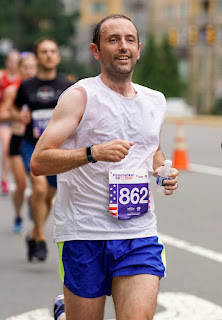
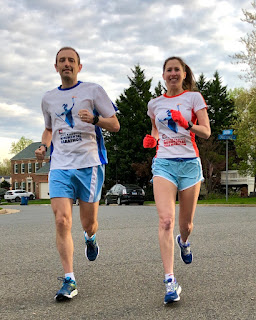
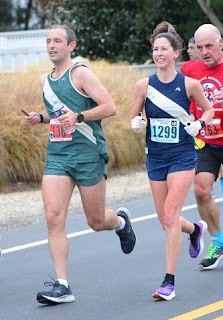
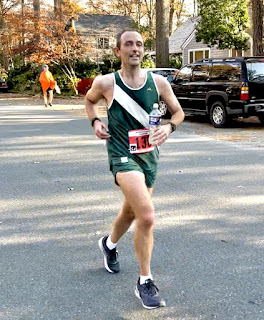
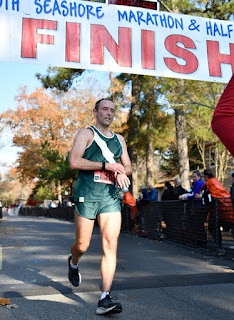
Please enjoy this guest blog post written by my husband Greg!
I ran the Rehoboth Beach Marathon in December. At dinner that same night, Elizabeth was already asking which one I wanted to run in the spring. She and I are different in that way – I wanted to continue reveling in my recent accomplishment, whereas she wanted to know, ‘what’s next?’. More than once we’ve had similar conversations where my answer is, ‘I’m not ready to think about that yet’.

So, I was happy citing vague desires like, ‘I want to go somewhere new and exciting’, ‘I want a good experience’, ‘I want nice scenery’, ‘Not too big’, ‘Not too small’, ‘It’d be nice if we had friends there’, ‘I like mountains’, ‘Not too too hilly’, etc. She, on the other hand, was readily presenting actual options that satisfied my criteria. I would be participating in detailed planning, whether I was ready for it or not.
We ultimately settled on the Vermont City Marathon, in Burlington, VT. Burlington was supposed to be nice, it would add a new state to my running list, and one of my best childhood friends lived nearby. We also later learned that our friends from Virginia, Chad and Maria, were also coming. Chad would run while Maria and their 11-year old twins would cheer us along.
Training and Recovery
A May 29th target gave plenty of time for a healthy recovery and training cycle. After maintaining a base between 20-30 miles per week plus some rowing, the real training began mid-February.
A May 29th target gave plenty of time for a healthy recovery and training cycle. After maintaining a base between 20-30 miles per week plus some rowing, the real training began mid-February.
Elizabeth created a 15-week training plan that steadily increased the weekly mileage from the high-40’s to the mid-60’s, including three cut-back weeks. I ran 6 days per week, including one medium-long run, one speed workout, one long run, and one recovery run.
Instead of just doing another training cycle, as I’ve done before, I wanted to challenge myself to be better this time. For me, that doesn’t mean running more miles, or working harder. It’s actually quite the opposite – my biggest area for improvement was getting better sleep. My sleep quality has steadily deteriorated over the years. I estimate it went from fair to poor over the past 4-5 years. Since sleep is one of the most important things for both physical and mental health, it was clearly the smartest focus.
Unfortunately, in this case, identifying the problem is way easier than fixing it. 12 weeks before the race, I eliminated alcohol. According to everything everywhere, alcohol is 100% bad and 0% good for sleep. This helped in certain ways, but it wasn’t a magic bullet. It was one variable removed, and resulted in a more regularly identifiable set of issues. 4 weeks before the race, I eliminated desserts. This helped a little more, but I still struggled. The final fix was eliminating screens after I finished working for the day. This seemed to be the final puzzle piece. My sleep got much better by doing this. Unfortunately, this was the hardest of all, so I didn’t end up doing it until the week before the race. I could say a lot more about all this, but it’s too much for this blog.
I was surprised with how much weight rapidly shed after quitting the deserts – I went from 173 lbs on February 19th to 162 lbs on May 20th with a sharp acceleration in those final weeks. So, sleep or no sleep, my efforts had many other benefits.
Travel, Arrival, and Impressions
Because Elizabeth already blogged about our experiences traveling to Burlington and the activities prior to the race, I’ll abbreviate this section.
Because Elizabeth already blogged about our experiences traveling to Burlington and the activities prior to the race, I’ll abbreviate this section.
 |
| Shakeout run on Saturday |
Goals and Strategy
My main goal is always to run a good race. That means pushing as hard as I can without giving up, but not so hard that I’m forced to give up. There’s obviously a lot that goes into that. Because my training cycle went so well and my physical fitness was good, I believed a personal record (PR) was realistic given the course and conditions.
My main goal is always to run a good race. That means pushing as hard as I can without giving up, but not so hard that I’m forced to give up. There’s obviously a lot that goes into that. Because my training cycle went so well and my physical fitness was good, I believed a personal record (PR) was realistic given the course and conditions.
Elizabeth was running the first half with me. I asked her to pace us for a 3:17:something. We decided that meant a ~1:40:00 first half and a ~1:37:30 second half. Planning for some extra distance, that meant averaging about 7:35 for the first half and 7:25 for the second.
The Race
Fortunately, I slept relatively well both Friday and Saturday nights before the race. Despite having a bib that allowed me to start in the first corral, at 7:00am, I started with Elizabeth in the 2-person marathon relay corral, which was the last corral, at 7:12am. This wasn’t a big deal; for me it was much more important to run with Elizabeth than to have the 12-minute earlier start.
Fortunately, I slept relatively well both Friday and Saturday nights before the race. Despite having a bib that allowed me to start in the first corral, at 7:00am, I started with Elizabeth in the 2-person marathon relay corral, which was the last corral, at 7:12am. This wasn’t a big deal; for me it was much more important to run with Elizabeth than to have the 12-minute earlier start.
Elizabeth had written the mile-by-mile pace plan on her left arm, incorporating adjustments for the hill profile and a gradual acceleration from a slower start to a faster finish. My job was to stick with her.
The race was two laps of the same course. So, I knew to pay attention during the first half so I’d know how to pace the second half by myself.
Miles 1-5
Even though we started slowly, we rapidly caught up with the slower racers from the marathon corrals that started ahead of us. We were going a few minutes per mile faster than ~80% of the people on a fully-crowded course. The other 20% were having the same struggle we were.
Even though we started slowly, we rapidly caught up with the slower racers from the marathon corrals that started ahead of us. We were going a few minutes per mile faster than ~80% of the people on a fully-crowded course. The other 20% were having the same struggle we were.
It’s not easy staying with a pacer while weaving through so many people going such a significantly different pace. It meant accelerating to get through a gap before it closed, or going around the outside, etc.
At one point Elizabeth had to slow me down. I have a tendency to accelerate to pass and then fail to slow back down. At other points, Elizabeth was assertively clearing the way for us by announcing ‘Passing!’ as she squeezed through a small gap. I’d follow with a ‘thanks’.
This type of weaving consumed the first five miles.
I can’t imagine trying to race at half-marathon pace through all that. This was definitely poor race planning.
Mile 1 – 7:44
Mile 2 – 7:43
Mile 3 – 7:48
Mile 4 – 7:45
Mile 5 – 7:30
Mile 2 – 7:43
Mile 3 – 7:48
Mile 4 – 7:45
Mile 5 – 7:30

Mile 6 was still very crowded but quite nice because it was on a path directly next to the lake. The scenery was serene and there was a beautiful cool breeze coming off the water. It was the most enjoyable section of the entire race.
Mile 7 was the least enjoyable of the race; It included a ~200 foot climb up the pedestrian Church street area I mentioned earlier. The surface was brick, so it was also necessary to watch your footing. Mile 8 started with a short and steep climb and ended with a long gradual climb. I knew the next time I’d be enjoying this hilly section was miles 20-21.
I had pulled ahead of Elizabeth on the hills. Partly because I’m stronger up hills, but also because she steps gingerly when the footing is questionable. She caught up though and we carried on together.
Mile 6 – 7:34
Mile 7 – 8:02
Mile 8 – 7:41
Miles 9 – 10

This section was made challenging by the turns and potholes. I noticed that I had pulled ahead of Elizabeth again, but this time she was on pace, and I was going too fast. I welcomed the throttling – there is no surer way to ruin a marathon than to go too fast too early.
Mile 9 – 7:31
Mile 10 – 7:43
Mile 10 – 7:43
Miles 11-13
Early during mile 11 I started pulling ahead of Elizabeth again. This time she told me she was falling behind and that I should go ahead. She told me the prescribed paces of 7:20, 7:30, 7:15. With that info, I was off. It was exciting to be responsible for my own pacing. The paces were fast too, which meant I’d be running downhill. These would also be the final three miles of the entire race once I had come around the loop again, so it was of particular interest to envision that.
These miles were also on a different section of the path by the lake. This time we were higher up, so the view was more majestic.
With all this excitement and newfound purpose in mind, I overdid it by a little bit, but not too much. It felt good and I was ‘easily’ able to crank out some fast paces.
Mile 11 – 7:16
Mile 12 – 7:17
Mile 13 – 7:13
Mile 13 – 7:13
One more time around
I hit the half-way point at 1:40:18 with a Garmin distance of 13.2 miles. 0.1 was more than I had expected to run extra, but time-wise, I was spot-on. My pacing strategy was to average 7:25 for the second half. I figured I could adjust the mile-to-mile pace around that based on what I remembered from the first half. I knew the first couple miles were slower. I knew there would be the glory mile by the lake followed by the hilly section, which I’d endure until the start of mile 22. Then I knew it was time to run the neighborhood hose and rock band gauntlet. And finally, I had those wonderful fast finish miles where I’d give it everything I had.
I hit the half-way point at 1:40:18 with a Garmin distance of 13.2 miles. 0.1 was more than I had expected to run extra, but time-wise, I was spot-on. My pacing strategy was to average 7:25 for the second half. I figured I could adjust the mile-to-mile pace around that based on what I remembered from the first half. I knew the first couple miles were slower. I knew there would be the glory mile by the lake followed by the hilly section, which I’d endure until the start of mile 22. Then I knew it was time to run the neighborhood hose and rock band gauntlet. And finally, I had those wonderful fast finish miles where I’d give it everything I had.
Having this segmented picture in mind really helped me with my mental game.

The course wasn't crowded this time. I’m glad I knew they had a challenging hill profile or I may have gotten discouraged with how difficult this section was. I felt my legs starting to ache and thought it was too early for that. The hills that I had such power on during the first half were much harder this time around.
Somewhere around mile 17 or 18 I passed my friend Chad. I was sad to see him because he had a 9-minute head start. So, I knew it meant he was having a hard time. I encouraged him to run with me, but he wasn’t having it.
Mile 14 – 7:29
Mile 15 – 7:32
Mile 16 – 7:32
Mile 17 – 7:25
Mile 18 – 7:24
Segment 2 – the lake and the hills
The lake mile lived up to my expectation. It was incredible.
The hills however had gotten bigger since I last left them. The sun was stronger. The day was warmer. Everything was harder, but I had two things going for me – first, I knew to expect that it’d be hard, so, no big deal. Second, I knew Elizabeth would be waiting for me at the top. We planned that as the ideal spot where she could come spectate as a way to help me get through it. It worked well. I was very happy to see her and it gave me a good boost.
Mile 19 – 7:15
Mile 20 – 8:05
Mile 21 – 7:36
Segment 3 – the neighborhood
Generally marathon miles 22 and 23 are among the hardest for me, mentally. They’re quite far, but not far enough as to where I believe myself when I try thinking that I’m ‘almost done’. If the race is going well, they’re like the boring part of the movie where it’s hard not to just turn it off. If the race is going poorly, it feels like being stranded in the middle of the desert or on the moon. Nothing is close enough and everything is too far away and there’s no hope in sight.
Generally marathon miles 22 and 23 are among the hardest for me, mentally. They’re quite far, but not far enough as to where I believe myself when I try thinking that I’m ‘almost done’. If the race is going well, they’re like the boring part of the movie where it’s hard not to just turn it off. If the race is going poorly, it feels like being stranded in the middle of the desert or on the moon. Nothing is close enough and everything is too far away and there’s no hope in sight.
However, this time they were nothing like that. This time they were just that one last little thing to do before the fun begins. This was a first for me. If Yogi Berra ran marathons, he’d agree it’s 90% mental and the other half is physical.
Mile 22 – 7:35
Mile 23 – 7:17
Segment 4 – the finish

I knew I was in really good shape because I was able to calculate that I would PR if I ran better than xyz pace based on the time on my watch and the distance left to go. Being able to do such calculations so late in a race, gave me even more confidence.
As I confirmed the pace on my watch was better than I needed, I had a positive feedback loop going on mentally and it carried me through to the finish. I gave it all I had for the final ~1.5 miles.
Mile 24 – 7:17
Mile 25 – 7:20
Mile 26 – 7:04
Final 0.41 – 6:57
Final time – 3:18:15
This is a PR by 1:36.
Post Race
Chad stayed strong and finished the race. He was beat up some, but felt well enough to join us for a celebratory dinner that night. It was great to spend time with them after not seeing them in person since the start of the pandemic.
Chad stayed strong and finished the race. He was beat up some, but felt well enough to join us for a celebratory dinner that night. It was great to spend time with them after not seeing them in person since the start of the pandemic.
Also, I really appreciated Maria and the kids cheering me on at four different points throughout the race. It was so much fun seeing them on the course.
On Monday we had lunch with my childhood friend Jim, his wife Rae, and their son, Andy. We haven’t seen them since our wedding, and we’d never met Andy. I really enjoyed our time together.
Reflection
I accomplished everything I set out to with this race. Both the journey and the destination provided life-enriching experiences which I treasure and am proud of accomplishing. After all, that’s the whole point, isn’t it? It’s got me asking myself, ‘what’s next?’.
I accomplished everything I set out to with this race. Both the journey and the destination provided life-enriching experiences which I treasure and am proud of accomplishing. After all, that’s the whole point, isn’t it? It’s got me asking myself, ‘what’s next?’.