Showing posts with label running injury. Show all posts

Friday, October 27, 2023

TFL Trigger Points and Iliohypogastric Neuralgia

On Friday, October 13th, I noticed that my right hip was aching while climbing stairs. Ever since then, my hip has been the bane of my existence! 

All-brick boardwalk in Miami Beach
I'm going to include the timeline of the injury mainly so I can remember it in the future and for anyone else who has a sudden hip issue arise. But it will be quite boring for anyone who isn't me or anyone not suffering from a hip injury. So feel free to skim through or breeze past it to the next section. (Even the title of this blog post is boring in order to be searchable by anyone else suffering!)

Friday, October 13:
In the morning, I ran 8 miles on the all-brick boardwalk in Miami Beach. I was in Miami getting ready to board a cruise in the afternoon. We had flown in Thursday night so we'd have a night to "chill" in Miami before heading out the the Caribbean. 

I met up with another Instagram runner, Stephanie (@stephpiruns), for an 8-mile run. Originally I had put 18 miles on the schedule as my last long run before MCM. But then I decided to back that down to 14-16 given the heat. And then when the actual forecast came out for it to be unseasonably warm and humid even for Miami (dew point of 82) I backed it down even further to just 8 miles. 

The run felt great from a hip perspective, although I was absolutely drenched by the time we were finished. 

A few hours later, we boarded the cruise ship and then ascended a few flights of stairs to our room. It was at that point I noticed a slight ache in my hip. Something that I had not felt at all during the morning run or at any point in my training. When we got to the room, I moved my hips around and felt a deep ache when I moved my hips to the right. Weird!

Saturday, October 14
The next day, I foam rolled and did some gentle stretching before starting my treadmill run. I only made it
about two miles when I realized this might not be a good idea given the state of my hip. I felt it with every step. And even though it was only a 1.5-2 on the pain scale, it was one of those "I have nothing to gain by doing this but a lot to lose" moments with the marathon just two weeks away.

October 15-October 18
The cruise was a nice distraction from the hip. I was able to keep a positive mindset and enjoy the cruise with minimal hip obsession. I was comforted by the fact that I didn't "do anything" to injure my hip during that 8-mile boardwalk run, unless the brick surface really irritated something. 

In the mornings, I would do foam rolling and gentle stretching and a lot of Googling to figure out the source of the pain. Initially I thought it was an IT band issue, but towards the end of the cruise I had settled on TFL strain. I did not run on Sunday. I did 2-mile runs on Monday and Tuesday, both of which confirmed the pain was still there. On Wednesday I rested it again and that was the day we disembarked and flew back home.

What did this feel like at this point?
For anyone experiencing a similar pain, it felt like an extreme tightness and deep soreness all around the Iliac crest (pelvis bone that juts out). Both in front of the bone and behind it. The way I felt this pain was by putting all my weight on my right foot and cocking my hip out to the side/back. Otherwise, I had no hint of any issues at all. I had zero pain at rest. Zero pain walking. Mild pain while running. And a deep pain with that one motion. 

Thursday, October 19
I was miraculously able to see both my doctor and my physical therapist on my first full day back home. Usually my doctor has a 2-3 month wait, but he recently switched practices so his patients probably don't know how to find him! He's an amazing doctor and has a reputation for being one of the best in the area for sports medicine. 

He diagnosed me with "TFL Trigger Points" which are spasms at the muscle fiber level. He treated it by performing wet needling with an ultrasound, showing me where he was releasing the muscle. He also injected cortisone to near the surrounding nerves. He told me I should be 100% by the following Monday and if not, I should go back to see him again.

Saturday, October 21
This day was when the freakout finally happened! I had been calm, patient and positive up until Saturday. But when there was seemingly ZERO improvement on a 2-mile test run, I found myself down in the dumps. I threw myself a huge pity party. The sulking lasted all day. The doctor thought I would feel much better by Saturday and yet nothing had changed. Thus, I was discouraged. Defeated! DEFLATED!

I did not run on Sunday but tried again on Monday, because Monday was supposed to be the 100% day. The first two miles were mostly pain free but after that, there was no denying that the pain was still there. 

Tuesday, October 24
I returned to the doctor and he said that while there definitely were trigger points when he had seen me the previous week, he thought there could also be a nerve issue. He identified the nerve as the Iliohypogastric nerve, which runs right over the iliac crest. It was time for more injections! This time the goal was to get cortisone around that specific nerve at the specific spot where it was most painful. The nerve he targeted last time was a different one. Using an ultrasound, he found the nerve, I told him where the pain was most intense, and he injected it. 

The doctor was confident in his diagnosis and treatment and confirmed that the bone and tendons were in
The red arrow is where the nerve hurts!

good shape. We just needed time for the cortisone to work around the nerve. 

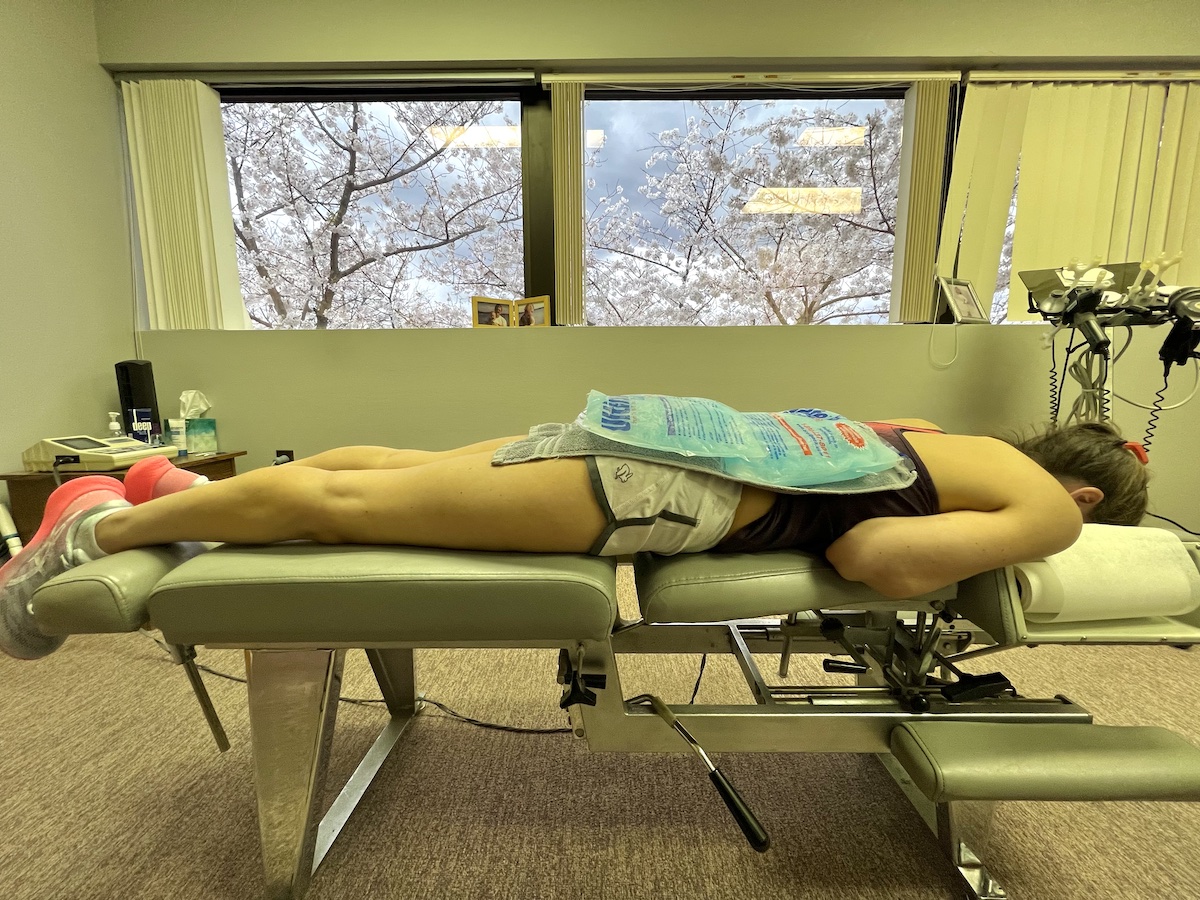
Per his direction, I rested on Wednesday and Thursday, making sure to ice the hip on a frequent basis.

Friday, October 27
With the doctor's green light to resume running, I tried running again today. And it was not 100% pain free, but the pain had changed quite a bit. Previously while running, there was a large area of soreness and tightness all around that TFL. Now, the area of pain was a quarter-sized area, concentrated right over the bone of the iliac crest. 

Imagine you bang your hip on something, it bruises, and whenever you touch it, it feels tender. That's what running felt like. Every step I took felt like I had a bruise that was being poked-- right over the bone. 

The good news is: 
  • The area of pain is smaller
  • The area of pain is quite superficial (close to the skin)
  • The pain didn't seem to worsen over the course of 4 miles 
  • The pain was never more than 1.5 out of 10 on the pain scale
  • I had no pain after the run, and I walked a full pain-free mile afterwards
The bad news is:
  • I am not 100% pain free
  • I am not sure what would happen if I did a long run or speed work
  • Definitely no Marine Corps Marathon (although would I have run it anyway in the 70-degree heat?)
What next?
In a situation like this, the only thing I can do is take it one day at a time. The doctor did a thorough exam and an x-ray and was confident in his diagnosis, so I have to believe it's just a nerve that needs to calm down and the cortisone will start to kick in over the next few days. 

In terms of running, my rule of thumb is to never let it go above a 2 on the pain scale. If it starts to do that, I will stop immediately and walk home or call Greg. 

I am eying Richmond and Philadelphia as possible backups. If I don't end up doing either of those, then I am not sure I want to keep marathon training this season. I'll just have to see how I feel.

I ended my pity party with acceptance, so now that I have reached that stage I am mentally handling things pretty well. I have accepted that a fall marathon might not be in the cards. It's frustrating and disappointing, but it's all part of running.

Thursday, April 7, 2022

11 Days To Boston: SI Joint Injury Update

I'm back again with an update, with a little more clarity than I had in my previous update.  I'll first provide a brief overview of the situation, then a detailed timeline (more for my own sake to remember how this progressed) and then I will do a little rant about of navigating the healthcare system. Feel free to skim, as this is admittedly a boring post. 

What I've learned since my last blog post:

  • MRI showed healthy discs. I have minor bulging, but nothing that would cause this type of pain
  • The root of the problem is very likely my SI joint 
  • That said, I do have some tendinitis around the left hip and a tight Piriformis, which are likely compensatory issues from bracing the SI Joint pain. It's one big chain reaction.

Progress since last blog post:

  • Walking is now pain-free 75% of the time, and during the other 25% it's slightly noticeable
  • I was prescribed a 6-day course of MethylPREDNISolone, and I have no idea if the improvement is from that or from my time off running. I finished it today.
  • I took 9 complete rest days from running, but I did do PT exercises and foam rolling
  • I didn't try to cross train because certain movements aggravate the area that aren't running, like leaning forward. Healing was my top priority; not maintaining fitness.
  • I received a cortisone injection into the SI joint today
Timeline
After seeing my doctor on Tuesday, March 29, I scheduled an MRI for the following Tuesday (which then I was able to bump up a day to Monday April 4). I wanted to rule out a bulging disc. 

March 30-April 3
I had zero change, zero pain relief Wednesday-Saturday, which was discouraging as I had stopped running entirely. My doctor prescribed a prescription for 1000mg a day of Naproxen, but that didn't help at all.

On Friday, I decided to get a second opinion from another doctor who ideally would be able to give me a cortisone shot, as I wasn't getting any relief with rest or with Naproxen or with PT/dry needling. This doctor was not at all helpful, but he did tell me to stop taking the Naproxen and instead start a 6-day round of MethylPREDNISolone. Those are steroids, which I started on Saturday, April 3 and finished today.

During this time I refrained from running and did minimal walking. But I did some light PT exercises for the hips and glutes, along with stretching and foam rolling. I also used my RapidReboot hip attachment for compression therapy. I didn't want to go too crazy with the PT exercises because I hadn't been prescribed any by my PT and I wasn't sure it was an SI Joint issue. I just did some common sense stretching and strengthening that didn't cause pain.

April 4-6
Monday was the first day I noticed some relief. Finally it wasn't painful with each step, so I figured the rest + steroids were working. Monday was also the day of my MRI. I actually somewhat enjoy having MRIs. It requires you to be alone with your thoughts; no distractions. A great mental toughness practice.

On Tuesday, April 5, after taking nine consecutive rest days, I decided to go for a test run. Pain with walking was almost entirely gone by this point. I ran with an SI Joint belt, which had been recommended to me by a few people on Instagram as well as a doctor friend. I don't think the SI Joint Belt helped, but I do like the support it provides while doing my daily activities. On Tuesday's run, I did a run/walk series, with the run portions getting progressively longer (2 mins, 3 mins, 5 mins, 7 mins) to see how things were feeling. Pain around the SI Joint kicked in about 15 minutes into the run. And then it quickly spread to the glute and hip and I ended up stopping at 22 minutes. This was extremely discouraging.

After the run/walk I foam rolled, stretched, used a massage gun, and took an epsom salt bath and things calmed down and were back to normal. 

I got the MRI report which I didn't quite understand, but my doctor friend told me it was all clear and that the pain was not disc-related. I have some slightly bulging discs, but they aren't causing me problems. 

My run the following day, April 6. was SO MUCH better! I ran for 4.4 miles, including a few short walk breaks. No SI Joint pain, but my hip did tighten up on me a few times, and I had to stop and stretch. This could be because I did not wear the SI Joint belt, and my PT told me later that day that I probably didn't need one because my pelvis didn't need additional stability. During our session he did an adjustment to help the hip, and he also performed dry needling on my back, glute, and hip. It was painful.

Later that evening, I had a virtual visit with my favorite medical provider, a sports chiropractor who recently moved across the country. He was my go-to for ten years and I trust his opinion entirely. I probably should have done this virtual visit two weeks ago, but I was skeptical that virtual would help much. In hindsight, I think he would have provided the clarity I needed sooner rather than a lot of the ambiguous answers I had been getting from other providers. 

This sports chiropractor has helped me overcome everything that has popped up over the years. Talking to him was very reassuring. I was on the fence about getting a cortisone injection and he was in favor of it. He told me what to expect, gave me some exercises and advised on how to proceed. 

Today, April 7, I ran 6.6 miles 100% pain free thanks to the PT session the day before. No hip tightening, no SI Joint pain. I ran it as a progression run because I had a ton of energy and threw in some strides. It felt amazing to be back out there again. I still decided to get the cortisone injection because I didn't want the pain to return, and today would be my last chance before my doctor left town. I learned that there are very few risks with cortisone in the SI joint, and the potential reward was high. 

I've had two cortisone injections in the past, but they were both somewhere in the 2007-2008 timeframe and not for my SI Joint. One was the ankle and I think the other was the knee, but it might have been the hip.

My plan is to take a rest day tomorrow to recover from the injection, do a short/easy run on Saturday and then attempt a longish run on Sunday. I'll have to play it by ear and see how everything feels, but that's the plan for right now. My doctor actually cleared me to run tomorrow but in general I feel like she allows me to run when I really shouldn't! 

Venting Frustrations
I think I would be much better off if I had a cortisone shot last week; but my doctor didn't have any availability on the schedule until today. I tried to get one at my initial appointment on March 29, but she said that she didn't have time during that appointment. I wish I would have pushed harder to get the shot right then and there instead of waiting 9 more days. Then I wouldn't have had to mess with the medications or the MRI. SI Joint injections are used for diagnostic purposes because if the pain goes away, then it was definitely SI Joint.

Instead, it was a roller coaster of trying different medications, scheduling an MRI and trying to get insurance to approve it (they did not), and not really knowing what the issue was or if I was going to be able to finish Boston. And it took a full week since my initial appointment to get real pain relief. 

I've spent so much time on the phone trying to schedule PT sessions, trying to get an earlier cortisone shot (without success), working through the MRI scheduling and insurance, trying two different prescription drugs. Basically feeling helpless, frustrated and uncertain!

It's much easier when you know what your injury is, how long it will take to recover, and clear instructions on how to proceed. (Like a stress fracture, for example). It's also easier when it doesn't pop up three weeks before the Boston Marathon. So while I handled Covid pretty well, and while I handled my groin injury pretty well, I really struggled with the uncertainty on this one. It was difficult to stay positive.

BUT, I think I am finally coming through to the other side and I'm done with the worst of it. I have the cortisone shot, I have two PT sessions set up for next week, I know I'm not dealing with a disc issue, I have guidance on how much to run and what PT exercises to do, I'm no longer taking medications, and I had a 6-mile pain-free run this morning! I had none of this on Monday of this week.

My primary goal is to get to the start line feeling good so I will prioritize that over trying to salvage my fitness. At Boston, my main goal is to finish the race and ideally be able to walk when I am done (or at the very least, to be able to walk later that day!)  I've already been to the Boston medical tent once and I have no desire to return. I also want a good finish line photo. I haven't been happy with my finish line photos from my previous Bostons!

If you read all of this. . . you're a real trooper! 

Wednesday, March 30, 2022

3 Weeks Until Boston and OUCH!

With less than three weeks until the Boston Marathon, an injury has popped up, bringing my training to a complete halt. I'm going to document all the details here, mostly so I can go back and reference them, but the punchline is that I am having issues with SI joint inflammation; something completely new to me. The joys of growing older! 

How it started
On Tuesday, March 15, I was doing deadlifts with the hex bar during a strength training session with my coach. I have done these many times in the past and I was using a slightly lighter weight than I had used in my previous session. As I completed the set of 5, I noticed a crunchy/pinchy sensation in my lower back/left upper glute. It was so minor that I didn't even tell my coach! When I do strength training I get little things like this a lot. I did a little jog-in-place to shake the legs out but the weird sensation remained. 

Ever since that session I have had a mild pinching sensation around the left SI joint. I didn't even realize this was my SI joint because I have zero experience with back injuries. I continued to run without any problems or pain. The following Saturday, March 19, I ran 18 miles with 10 at marathon effort (pictured). Even though I felt a little pinch the whole time, it didn't impact me at all and seemed totally minor.

How it progressed
The first red flag was on the following Tuesday, one week after the deadlifts (March 22). I ran a very challenging workout that combined track intervals (1600, 1200, 800, 400) with road miles in between each interval at tempo effort. The workout went really well and I had no pain whatsoever. I hit all my desired paces. Greg took videos and my gait was totally even and balanced. 

When the workout ended, that minor pain in my lower back became much more prominent. In fact, it hurt to walk! I walked a little bit and then I began my cooldown. My cooldown was very uncomfortable. I noticed that the slower I ran the more it hurt, but I obviously wasn't going to run super fast on a cooldown. So I cut the cooldown short because my lower back/SI joint was painful. 

I told my coach about it and we had a zoom meeting to discuss it. At that point it really seemed like it was a tight glute medius. That seemed to be the bigger problem than the pain around the joint. I'm guessing that the joint pain was exactly the same but that the running caused all the surrounding muscles to tense up, so now I had muscular tightness as well.

March 22 track/road workout
I went to physical therapy the next day and my PT said that my glute medius was extremely tight and also that one leg was slightly longer than the other. He did something to get the legs the same length again and did deep tissue massage on the glute. We also did some exercises to get me using the glute normally. I told him I had a hill workout the next day and he said as long as it didn't bother me while running, I would be fine.

So the following day, Thursday, I ran a hill workout with tempo runs in between the hill sprints. Running up and down hill felt fine. The tempo run felt fine. I could feel a slight pinch, but it was totally mild. BUT - just like Tuesday, the cool down run was very painful. I was stiff and it was hard to move. 

By Friday, my glute muscle seemed to be in good shape but now the lower back pain around the SI joint was more prominent. That's when I decided to see a chiropractor. In retrospect, I should have gone to the chiropractor the day after I deadlifted (9 days earlier) but I didn't think to do that because it was such a minor issue. He told me my SI joint was out of place and he gave me an adjustment to put it back in place. I unfortunately didn't feel any relief from the adjustment but he said it worked so I assumed everything was ok. 

The final straw
The next morning (March 26), it was time for my longest run of the cycle: 23 miles. My plan was to run from Leesburg to Falls Church on the WOD so that the run would feel like it had a purpose vs. an out and back. Greg and I would drive to Leesburg, he would run the first 8 miles with me, turn around, get the car, drive to Falls Church and pick me up. 

I was nervous about this run and I was debating if I should even do it. On the one hand, I had visions of the run making the issue so much worse and having to stop on the trail. On the other hand, things felt fine and I really wanted to do the 23-mile run. I was totally looking forward to it and once that was complete I told myself I could take a few days off if needed. I wish someone had told me that you should take it easy the day after a chiropractic adjustment. But I hardly ever get adjustments, so this is all new to me. Also, if I knew that was the case, I may have delayed the adjustment until after the long run!

Greg and I ran 8.5 miles together and then it was time for him to turnaround. I did feel the pain around my SI joint, and it was slightly worse than it had been on the previous weekend's long run. But still manageable. When he turned around, I was fairly confident (let's say 80% confident) that I would be able to make it to 23 miles. Or at least 20, which would still be plenty. 

I continued on my own and I stopped briefly at mile 10 to toss my water bottle in a trash can and take a gel. I noticed that my glute and hip were a little annoyed, and the first few steps after the stop were difficult. But once again, totally manageable. But after another mile or so, things really started to go south! My hip started seizing up, my glute was in pain, and my lower back hurt even more. Over the course of 5 minutes, everything started going crazy until I was forced to stop. At 12.09 miles.

I was about a mile away from a shopping center where I could sit inside a Starbucks, call Greg from my Apple Watch and wait for him. But I couldn't walk! I just stood there on the side of the trail feeling paralyzed. Lots of people asked me if I needed help but I told them I would be fine and I was going to call for help. Thankfully, I was very close to a break in the fences/grass/trees that surround the trail and was able to slowly get myself into the back of a parking lot of an office park. If this had happened at mile 15, 16, or 17 I would have been screwed because that's "no-man's land" and there are very few trail exit points.

The pain got pretty bad and it brought me to tears. I knew that Greg still had to run 4-5 miles back to the car in Leesburg so I called my friend Cheryl who lives in Reston. I knew I was in Reston (it was technically Herndon) and I gave her the name of the of the business I was standing in front of so she could find it on Google and come to me. The main reason I needed Cheryl was because it was 49 degrees and I was wearing a tank top and shorts. That's perfectly fine attire if you are moving, but it got cold very quickly when I stopped moving. She found me shivering with blue lips and gave me her jacket as I sat in her warm car. There, she gave me tons of info on SI joint pain (she's dealt with it) and we waited for Greg to come pick me up. Greg called the chiropractor who I had seen the day before and got me in to see him immediately. Thank goodness!

The chiropractor said the SI joint was still in alignment but now the hip was out of alignment and all the muscles around the glute and hip were extremely tense. He corrected the hip, but I still had a ton of difficulty walking around the rest of the day. 

Recovery
I spent the rest of Saturday and all day Sunday icing the area, taking Aleve and using my Rapid Reboot compression system for the hips and glutes. I already had a massage scheduled for Sunday and she did deep tissue work and cupping. Most all movements were difficult. Especially going up stairs, bending over and sneezing. Sneezing was the worst of all. 

On Monday I was back in my PT's office for dry needling and a walk on the Alter-G anti-gravity treadmill. The walk was to help my brain realize that everything was okay, I could walk normally, I didn't need to tense up and brace for pain. On Tuesday I was able to get in with my sports medicine doctor who finally provided me with some clarity on the situation. 

Official Diagnosis
According to my doctor, it's most likely SI joint inflammation with tension of the surrounding muscles and inflammation around the hip (trochanter). She said there was a slight possibility that I had a bulging disk, which could only be ruled out through MRI. I definitely wanted to rule out a bulging disk, so I am getting an MRI next week.

Because it's most likely inflammation and muscle tension, she prescribed a therapeutic dose of Naproxen (NSAID) and continued PT. If my symptoms don't improve within a week I will go back for a cortisone injection. Normally I would try to avoid an injection, but with Boston coming up, I will do whatever is needed to get to the start line feeling good.

So for now it's rest, PT, and NSAIDs. Once I start to feel better I will attempt running again. I'm going to be fairly conservative, as my goal is to get to Boston feeling good. I don't think I can salvage much training at this point. Most likely it will be a full week off of running and then short, easy runs as I gradually return. 

I can now walk with a normal gait and the pain isn't anywhere near what it was over the weekend. I am seeing dramatic improvements each day and I hope this trend continues. This certainly sucks, but I wasn't trying to PR at Boston anyway. I just want to be healthy when I get there. 


Monday, June 28, 2021

Focusing on Form

I've now been running for 3 weeks after taking 8 weeks off for my Osteitis Pubis and torn adductor. As I said in my last post, I am using the run-walk approach to gradually get back into my normal routine. So far my longest run has been 5 x (9 minutes running, 90 seconds walking). That adds up to 45 minutes of running total.

I'm probably at a point where I can start to get rid of the walk breaks but I like them because 1) it's crazy hot and humid and I need my heart rate to come down and 2) I'm 100% focused on my form and stride and I need a mental break from that. It's also good to check in to make sure everything is feeling good and nothing is hurting. I would hate to finish a run and realize I made the injury worse but didn't get that feedback immediately.

I went to the doctor last week and she was pleasantly surprised at how quickly I was recovering. She gave me and exam and tested my strength as was impressed that I had made such progress. It wasn't a guarantee that this adductor tendon would heal on its own, but thankfully it's most of the way there and I won't need surgery or any other kind of procedures. Just the dry needling which I stopped about a month ago.

A note to subscribers
Before I get into the meat of this blog, I have an update for my subscribers. After this post, Feedburner is going away and I am using a new email system called Feedblitz. You might get an email asking you to confirm your subscription. So if you do, please confirm it so you can continue receiving emails. If you are NOT a subscriber and want to subscribe via email, there is a form on the right column of the desktop version, or you can subscribe at this link. (I know it looks a little sketchy, as I designed it to fit on the sidebar of the blog desktop version. Just click subscribe, enter your email and click subscribe again.) If you already get emails, no need to fill out the form again.

Issues with my running form
Back to the topic of this blog. Fixing my stride will not only prevent this injury from coming back, but it will make me a stronger and more efficient runner. 

I have always been a "shuffle runner". I wouldn't pick my feet very high off the ground and drive forward with the knee. My stride was short, partially due to limited range of motion in my ankle. In order to offset
Drills before running
this and still run fast (like a 5:52 mile) I adapted by having a very high cadence. Most runs would average 200 steps per minute and speed work would sometimes average 210. My feet would stay super close to the ground and move very quickly. Like shuffling!

Another form issue was that when I landed on my left foot, my right hip would drop down, making the pelvis unstable and uneven. This is a common issue with runners and can lead to injuries. It indicates instability and lack of glute activation. I also had this issue on the other side, but it was not nearly as pronounced. It makes sense that I tore the left adductor because I wasn't activating the left glute when I landing -- the right hip was dropping.

I have known about this hip drop issue for over a year now and have been working on it with my strength training coach. I have strong glutes! The problem is that my body doesn't naturally tap into that strength when running. It prefers to use the adductors. If I were able to access that power, I would be a more efficient (faster) runner and be protected from re-injuring my pubic bone.

Changing movement patterns
Working with my Osteitis Pubis specialist in Australia, live video feedback or mirror feedback has been essential. The focus is on doing all the PT exercises 100% correctly. It's not about doing them to get strong (although some of them build strength). It's about teaching my body to have a stable pelvis when put under different types of stress. There are literally over 100 exercises. I am not exaggerating. When I say "literally" I don't mean it like a millennial. I mean literally over 100 exercises. It would be overwhelming to do them every day, so the point is to progress through them one step at a time adding more stress and complexity while keeping a stable center of gravity and a pelvis that is controlled.

There is a huge focus on deadlifts, bird dogs, downward dogs, and side planks. There are many variations of each that challenge pelvic stability in different ways. Being able to see myself on video or in the mirror has enabled me to ensure I am doing the movements correctly, which ultimately translate to running. 

Greg has been recording videos of my running so that I can analyze my stride afterwards. He records some of them in slow motion so I can really see where I need to pick the legs up higher or keep the pelvis more stable. Drills have also been important in reinforcing the correct movement patterns, provided that I am doing the drills correctly. 

Here is what my hip drop looked like last summer:


Here is what it looked like yesterday:


And here is a back view, which is much more noticeable, taken last summer:


This was taken on Saturday - notice the difference:


My knees still come together, but that's just my anatomy. When my feet are pointed straight ahead, my knees go in. When my knees are straight ahead, my feet turn outwards. My PT said that was fine and you can't fix your anatomy! The important thing here is that the line of the top of my shorts is straight across rather than slanted down, like in the green shorts from the previous photo.

What I think about
As I said earlier, I need the walk breaks because focusing so much on my form is mentally exhausting. There are only so many mental cues you can give yourself at a time. Here are a few of them:
  • Feel the glutes working
  • Engage the core to keep stable
  • Keep the spine elongated
  • Shoulder blades down
  • Lean forward from the ankles
  • Drive forward with the knee
  • Use gravity to fall forward
  • Most of the weight in the forefoot
  • Stable foot "tripod" when landing
  • Remember deadlift form
I hope this way of running becomes automatic. I honestly have trouble running slowly when I do this. It's easier to open up the stride when you are running fast. This normally wouldn't be a problem but I don't have the cardio fitness to support the faster paces, and it's crazy hot and humid! My heart rate has been averaging in the 170s for the run segments because I am out of shape and it's hot. My paces range from 8:10-8:30 once I get going. That used to be my easy pace but it's not my easy pace right now, and it's definitely not my easy pace in the heat. So hopefully I will get the hang of it and be able to run in the 9:00's so I won't be dying in the heat. 

I'm on track with my plan to build a base in July and start marathon training in August for Richmond!


Saturday, June 12, 2021

Back on the Roads!

After 8 full weeks of zero running, I have started back up again. Very gradually!

I was not exactly sure when it would be safe to return. My physical therapist cleared me to run after 7 weeks, but I felt like I needed an extra week. I still felt the injury with certain movements and I wanted more confidence that I wouldn't hurt myself. Meanwhile, the Osteitis Pubis specialist I am working with in Australia doesn't advise running until stage 8 of his program- which I won't reach for another few weeks.

The physical therapist tested my strength and was confident that I was far enough along in my recovery

that running would be ok. My adductors, glutes, abs, hamstrings -- all have a healthy amount of strength to support running. He gave me a return to running program that seemed too aggressive so I decided to use a more conservative program from my strength coach, Angela. I'll use her program at least initially, and if I feel like I can progress faster then I will switch back to the PT's plan. 

Monday, June 7
For my first "run" back, I did 6 sets of 0:30 running, 4:30 walking. Essentially this was a walk, with six 30-second jogs thrown in. This was discouraging. I felt the injury more than I expected to. I tried focusing on my form and just being really purposeful about my movements but I still felt irritation in the pubic bone area. I did have some hope, however, in that a few of the reps felt decent. I would say about half them felt pretty good and the other half did not.

Did I do too much too soon? As soon as I stopped the running portions, walking felt 100% pain free. And I didn't have any hints of the injury for the rest of the day or the next day. What a relief. This means that my 3 total minutes of jogging didn't make things worse and I could proceed with the plan,

Wednesday, June 9
Building on Monday's session, this time the 5-minute blocks were split as 1-minute run, 4-minute walk. Twice as much running! I was a little nervous heading into this but I was pleasantly surprised that I had very little pain. I felt WAY better than I did on Monday! I was very encouraged by this. So what made the difference between Monday and Wednesday? I think it's a combination of:

  • I focused more on my posture and pulling the shoulder blades down. This was feedback I got from the Australian specialist when doing a Bird-Dog exercise during our Tuesday session.
  • My body needed to get the message "Hey, we're running again, and it's okay" and shake off some of the cobwebs
  • My body needed to recover from a run and realize "that didn't cause an injury"
I've learned that the mind-body connection is REALLY important in recovering from an injury. The brain becomes used to feeling pain with certain activities so you need to train it to not feel pain once you can do those activities properly.

Friday, June 11
No injury flare ups or pain all day Wednesday or Thursday, so I advanced on Friday to 1:30 run/3:30 walk. This was also encouraging although not perfect. I would say that maybe 5-10% of my steps triggered a mild pain sensation around the pubic bone, but the rest were fine. Some of the reps felt much better than others. Once again, I really focused on my form. Several key items:
  • Fall forward as you run - let gravity help
  • Keep a straight spine with the shoulder blades down
  • When landing, ensure that the toes are spreading to form a stable platform
  • When pushing off, observe the firing of the glutes
  • Breathe through the core to help engage the core
I am encouraged by all of this and I continue to work with the PT, the Australian specialist, and my strength coach. I think my biggest issue is stability, which can be improved by glute activation. My lack of stability causes my pelvis to move too much, which is not good. My PT also discovered that I have extremely tight glutes and I fail his strength tests before massaging them out with a lacrosse ball. After the massage, my glutes start to work. So I should be using my massage ball on my glutes before each run.

I continue to swim 3-4 times a week, and I have gotten my swims up to one mile. Last week I swam 4 miles! I joined an outdoor pool so even once I am back to running full time, I plan to incorporate swimming. We also bought a rowing machine which is also great for cross training.

Long term plans
In an ideal world, the next six months will look like this:
  • June: Run/Walk, be able to run continuously for 40 minutes by the end of the month
  • July: Build a mileage base, introduce strides and some introductory faster workouts
  • August: Begin training for the Richmond Marathon, include long runs and tempos, run a 5K
  • September - October: Richmond Marathon Training, run a 5K and a longer distance
  • November: Richmond Marathon
My physical therapist is confident I can progress at this rate and so am I. As for the Boston Marathon, I plan to use my Two Rivers Marathon time to qualify for the April 2022 race. I have a cushion of over 20 minutes, so I'm confident that I will be accepted!

Monday, May 24, 2021

Recovery from Osteitis Pubis

My recovery from this Osteitis Pubis injury has been more involved than any other injury I've ever had. To recap, I have a partially torn adductor with "moderately severe" Osteitis Pubis according to my MRI from April 25. You can read my previous post for all the details. 

Physical Therapy
I started seeing a pelvic floor physical therapist in the middle of April, twice per week. Each time I go she gives me a new set of exercises to do. She started with simple, easy exercises such as the Kegel (pelvic floor contraction) and abdominal squeezes. I don't know the official term, but it's basically just sucking in on the lower abs. Over time she has given me more strengthening exercises like squats, adductor raises, clams, and more. 

In terms of treatment she's done dry needling which hurt so, so much, as well as blood flow restriction therapy. Blood flow restriction therapy wraps a tight band around your quad that feels like a blood pressure machine. It squeezes just like a blood pressure machine while you perform squats to help make greater strength gains with a lighter load. The dry needling, painful as it is, has really helped me feel more normal when walking around. 

I do the exercises nearly every day, in combination with the other items below. These exercises are designed to build strength in the areas around the injury so that when I start running again, everything will be strong enough. 

Strength Training
While the physical therapy exercises are designed to rehab anyone with this injury, I am working with the same strength coach I've had for over a year on making sure I maintain my overall body strength during this time. I would be doing this even if I didn't have an injury, and she has tailored the program to focus on the areas that need the most help: deep core, glutes, adductors. These exercises are more challenging than the PT exercises, involving weights and resistance.

The OP Clinic
I was referred to the OP Clinic in Australia by a friend who also had this injury. He does virtual sessions over Skype. He specializes in OP and the purpose of his program is to rewire your mechanics and movement patterns so that you don't overload your pubic bone. The sessions are a very small part of the program. He has given me a self-guided program with "homework" exercises that I learn through videos. I send the videos to him as soon as I am able to complete the exercises properly and he reviews them and lets me know if my form is correct or where I need to improve.

The program starts with basic core breathing, establishing a strong center of gravity, and having correct form for basic exercises like the deadlift. It's an extremely intense program and so far I've spent over an hour each day watching all the videos and going through each exercise. Stability is the key focus, and in order to be stable you have to engage your core and glutes. It's challenging to upload videos to this blogging platform but if you follow me on Instagram, I post videos to my story all the time. 

Right now I'm focused on learning how to do the perfect deadlift. This involves breathing properly, having the right center of gravity, engaging the glutes, moving slowly, keeping a straight back (not hunched or arched), and feeling the "fascial tension" as I slowly perform the movement. I am doing deadlifts with bands and on my forefeet to ensure I am not rocking back into my heels. 

The OP Clinic is a 10-stage program and by the end of it, I should be able to run as much as I did pre-injury. Because my mechanics will have changed, I will no longer be overloading my adductors. There is no timeline for how long this will take. I can get through the program at whatever pace I am able to. The program isn't necessarily designed to heal; the body does that on its own. It's designed to help patients stop overloading their adductors and pubic bone. Here's how I see all of these working together:

  • Physical Therapy: Helps the injury heal with different therapies and exercises
  • Strength Training: Ensures I have the strength needed to support an intense training load
  • OP Clinic: Overhaul of my running mechanics so I don't keep injuring the area
Cardio
In addition to the above, of course I want to maintain some level cardiovascular fitness. I started swimming two weeks ago, once I felt like it would be safe to kick my legs. It turns out I don't have a great freestyle kick to begin with so swimming is 100% fine. Due to Covid, I have to reserve a lane a few weeks in advance so planning has been tricky. 

Swimming
I've been swimming 3-4 times per week. I swim freestyle, and that's my only stroke! I know how to do the others but the breast stroke kick wouldn't be good for my injury and I'm only good for about two laps of butterfly before I fatigue. My typical swim is 20-25 laps, lasting about 30-40 minutes.Yesterday I introduced pool running with the belt. I did 5 minutes yesterday and 10 minutes today after my swim. My plan is to very gradually ramp up the pool running because I do not want to strain the adductors. 

I enjoy swimming, but it's a high maintenance activity. I have to reserve my lane in advance due to Covid capacity restrictions at the pool. Once I get there I have to lather up with pre-swim lotion so that my skin doesn't get irritated. And then get all situated with my swim cap, googles, and waterproof mp3 player. And when I am done, I have to shower there to immediately remove the chlorine from my hair and skin. I think I spend more time driving to and from the pool + getting ready and showering than I actually do with the swim. 

Walking
For the first few weeks I was hobbling around and not properly balanced. I could feel the injury with each step even though it wasn't painful. About a week ago I got to a point where I could walk and not feel the injury! Huge progress. I have been taking 2-3 mile walks and loving it. The weather has been gorgeous and Greg and I even went to Burke Lake park one afternoon to walk. We also took a few days off work to go to Annapolis and I did a lot of walking around there. All pain free!

I'm averaging about 60-90 minutes of strength/PT each day and then another 40-60 minutes of cardio (walking and/or swimming). It's more time consuming than running but it's what I need to do to get back out there again while preserving my sanity!


Friday, May 7, 2021

Running and Osteitis Pubis

Osteitis Pubis. Sports Hernia. Athletic Pubalgia. These three terms refer to a set of conditions that result in groin pain in athletes. They all have slightly different nuances, but all of them mean you shouldn't be running.

I briefly touched on this in a previous blog post, but I will get into all the details here. 

How it started
In July 2019, I had a bike accident while on vacation in Norway. The bike tire got caught on a rail track, stopped the bike, and I fell onto the pike, bashing my pelvis into the bike bar with a ton of force. This resulted in massive bruising, a ton of pain, and 9 days off from running. I went to several doctors at the

time and they all agreed it was a hematoma and it was okay to run as tolerated.

The damage from this accident never healed completely. Sometimes I would wake up in the middle of the night with my pubic bone aching. I could never do a sit-up without my lower abdominals feeling strained. Certain adductor exercises were painful or not even possible. 

But it didn't impact my running or my daily life; it was sort of lingering in the background Since the accident I have run 4 marathons (CIM, Boston Virtual, Harrisburg, and Two Rivers). I did irritate it during CIM, but it was silent after Boston Virtual and Harrisburg. But due to the slant of the road at Two Rivers, the adductor finally said "I've had enough!" I think that was the breaking point.

I did have some warning signs before the marathon, though. After my long runs throughout March I would feel a tenderness in the groin area. And once I felt some groin pain at the end of a 22-miler. 

Post Marathon
Immediately after the marathon, the left side of my pubic bone was in a lot of pain, but it subsided within 24 hours. And then I took a week off of running and I felt 100% normal walking around. I actually did quite a bit of walking at the chess tournament (one week after the marathon), logging over 8,000 steps, and felt completely normal.

When I returned to running, my pubic bone area started to hurt right away. It wasn't severe-- it was about a 2 out of 10 on the pain scale. The lower abdominal muscles were also a bit tender. Since I was just coming back from the marathon, I kept these runs slow and short. And I didn't run every day. I think it was a total of 5 short runs over a 9 day period before cutting it off completely. The last of these runs was my longest: a 5-miler. After that run, I began to feel the pain while walking. I have not run since April 13. 

I went to a doctor and my sports chiro and ultimately ended up getting an MRI (this was after the mandatory X-ray needed by insurance). I wish I had gotten an MRI immediately after the bike accident so I would have known I needed some rehab, but I didn't advocate for myself with the doctors. And they reassured me it would heal with no problems.

MRI Results + Diagnosis
This is taken from the report:

Pelvic joints: There is joint space narrowing and marginal osteophytosis with subtle erosive centered on the pubic symphysis. Marrow edema noted at the pubic bone centered on the pubic symphysis and there is

Image from Sports Injury Bulletin
synovitis within the pubic symphyseal recesses. The hip joints are preserved. Small bilateral joint effusions are seen in the right and left hips. No prominent anterior superior superior labral tears are identified.

Muscles/Tendons: There is focal high-grade partial-thickness tearing of the rectus abdominus adductor longus aponeurotic insertion on the left pubic bone (series 2, image 10). The visualized muscles and tendons are normal.

When I first read the report, I panicked. It sounded like there was a crap ton of stuff wrong! I was particularly worried about the bone marrow edema because that can become a stress fracture. The high-grade tearing of the muscle/tendon was also alarming. 

After I had my PT and doctor interpret this, it didn't sound so horrible. Key findings:

  • Osteitis Pubis - inflammation in the area around the pubic synthesis
  • Partial tear of the adductor muscle at the insertion point
  • Bone marrow edema
In the diagram, the tear is located where the adductor longus meets the pubic tubercle, and I have pain in the area around the inguinal ligament + rectus abdominus. 

The most likely scenario is that when I had the bike accident, it never healed properly and it resulted in my muscles overcompensating and "learning" how to fire incorrectly to compensate for the weakness. There was a good amount of scar tissue on the MRI and the doctor said that doesn't happen within a few weeks- it takes a long time for that much to build up. Once I tore the tendon - which could have been during the marathon or during training - then additional strain was placed on the pubic bone, causing bone marrow edema and inflammation. So we think the partially torn adductor is the culprit. . . and that was caused by muscles not properly firing, resulting in an imbalance.

So this is an overuse injury, but it would not have happened if the bike accident didn't damage that area to begin with. It was like a ticking time bomb.

Moving Forward
I have been in physical therapy for three weeks now. I am working with a pelvic floor specialist and she's given me a ton of exercises. We have done blood flow restriction and dry needling. The dry needling was like torture. She has dry needled my adductor, my pelvic floor, my abdominals, and my hamstring. OUCH!  But that needling has honestly brought about the best results. 

When I stopped running on April 13, I started talking daily walks for the next two days, but then I stopped that because I felt like it was too much. It seemed to get worse and worse, with it being painful for me to walk around the grocery store on the weekend of April 24. That's when I felt like I would never get better!

But today, on May 7th, it feels a lot better to walk. I do feel it when I walk but it's only about a "1.5" on the pain scale - a minor annoyance. Maybe enough to make me limp a bit. And my doctor actually recommended that I take a 30-minute walk each day. Anything that involves the lower abdominal muscles or the left adductor doesn't feel right, so there is a constant reminder that I have this injury. 

Now I am focused on doing PT exercises each day, and getting the dry needling twice per week + blood flow constriction therapy. I'm also using my Theragun to massage the adductor and lower abdominals. 

PT exercises include:
  • Single leg deadlift (no weight yet)
  • Squats with a band wrapped around my upper back, anchored to a weight rack
  • Kegel exercises
  • Bear stance hold
  • A 3-part clamshell type exercise 
  • Calf "crunches" with a band to improve ankle range of motion
  • Toe yoga to improve balance
  • Squeezing a soccer ball between my feet

Recovery Timeline
The doctor couldn't give me a definite timeline and he couldn't even guarantee that the tear will heal itself. He said it would likely heal without surgery if I do my PT exercises regularly. At this point, the earliest I would start running again (and by running I mean a gradual run-walk introduction) would be the end of May. Early June is probably more likely. 

Worst case scenario would be surgery or simply taking 3+ months to heal. The longest I have ever taken off for an injury was 5 weeks back in 2009 when I had peroneal tendonitis. That's maybe tied with my stress fractures from 2011. I think that was 4-5 weeks, too. 

I've taken 3 months off due to mono on multiple occasions, but I've never had to take more than 5 weeks for an injury. I guess I should be glad this isn't mono and I know it's going to heal 100%. It just requires extreme patience. The silver lining is that I will be stronger when I come back because of the daily focus I have on stability, strength, and mobility exercises. 

Attitude and Perspective
Compared to previous injuries and bouts of mono, I am not that upset about this one. Even though it's the worst injury I've had - I am tolerating it much better.  Why?

  • I felt like I needed a long break after the extended training cycle for Two Rivers. I ran 3 extra weeks at 75+ miles each, and I think those 3 extra weeks took a physical and mental toll.
  • I don't have any races on the calendar
  • Summer is coming up, so I wasn't planning on setting any PRs in the near future
  • I have always set massive PRs after coming back from mono, so I think a long break will ultimately lead to a breakthrough in fitness
  • I can enjoy the extra time by honing my chess skills and tackling other projects around the house
I hope the road to recovery isn't too long. I've mentally accepted that I likely won't be back on the roads until early June. I'm also prepared for it to be longer. I am still optimistic about a late fall marathon, although I haven't chosen one yet. 

Saturday, January 18, 2020

Posterior Tibialis Tendonitis

In 18+ years of running, I certainly have made the rounds of all the different types of tendonitis!

Patellar Tendonitis: Spring of 2008
Peroneal Tendonitis: Fall of 2009
High Hamstring Tendonitis: Summer 2013
Achilles Tendinitis: Fall of 2017

I can now add to the list Posterior Tibialis Tendonitis. Here's how it happened.

December 8: CIM
Before CIM. No tendonitis!
Upon completion of the marathon I noticed a pain in my arch. It hurt as I walked back to the hotel, and when I took the Vaporfly Next% off of my foot- OUCH. It was a burning pain of about 6 out of 10 on the pain scale. It seemed as if the shoe had been rubbing against my foot in a certain way to cause this arch pain. It bothered me for the rest of the day and and into the following day.

December 9 - 15: Marathon recovery
The pain went away completely two days post marathon. So much so that I forgot about it.

December 16 - 20: Easing back into running
I resumed running with short, easy runs of 30-50 minutes. I didn't have any pain in my foot.

December 21: First post-marathon symptoms
I did an 11-mile long run and the arch of my foot started to hurt about halfway through. It was maybe about a 2 on the pain scale, so I wasn't concerned. As I walked around on it for the rest of the day, I noticed that it felt off, kind of like a tight muscle.

December 22 - January 9: Blissful Ignorance (or denial)
I continued to train, doing hard workouts on the track and long runs of 10-13 miles. I even ran a 5K on New Year's Day without any problems. My foot would bother me a little, but it was more of an annoyance than anything else, never getting above a 2 on the pain scale.

After my long run on January 4th, my foot hurt more than normal, which caused concern. It was mostly okay during the run, but afterwards it was about a 3.5 to 4 on the pain scale for the rest of the day. Very tender to the touch and I could feel it with each step. That's when I realized I would probably have to address it. I continued with my training plan and track workouts until I could get in to see my physical therapist on January 9.

Diagnosis!
It didn't take long for my PT to diagnose me with posterior tibialis tendonitis; I had classic symptoms. The two areas of pain were on the bottom of my foot, where the tendon connected, and on the side of the foot, about one inch forward from the ankle bone, and one inch below. He told me I would need to take some time off running to let it heal. Not the news I wanted.

Area of pain - feels like a sore ache
This issue wasn't caused by "overuse"-- it was caused by my shoe rubbing the wrong way during the race. So how does that result in tendonitis?!  My PT had a theory that it could have been because the shoe had an 8mm drop (as opposed to the 10mm I normally wear) and it was extra bouncy, causing my foot to pronate, where it normally does not pronate. Or, it could have been rubbing against my arch the wrong way, which irritated the tendon, and now it's going to take a while to calm down.

So. . . couldn't I just train through it like I trained through Achilles tendonitis? He said that this was different and I needed to ease up to give it time to heal. Of course, in addition to doing exercises. He was concerned that I took a week off post marathon and it came back. And he said that this is a nagging injury and tends to come back unless you treat it with the exercises over several months.

January 10 - 13: No running; pool workouts only
I took four full days off of running, but I went to the pool every day. I mainly did deep water running with a floatation belt, but I also added in some swimming to save myself from boredom. And I simply enjoy swimming. I would do it all the time if it were more convenient.

January 14 - now
After my four days off, I started running again, but only 3-4 miles per day. And that's where I am at now-- I just finished a 3.5 mile run in the snow. And of course, I have been religious about my exercises. Rest alone won't heal this; I need to load the tendon with weight.

I'm now at a point where I don't feel any symptoms while walking around during the day, which is a big improvement. However, after about two miles of running, I do start to feel some soreness on the bottom of my foot. Since I'm only running 3-4 mile easy runs, this pain has been about a 1.5 to 2 on the pain scale, and I am back to being symptom free five minutes after stopping.

I also bought a pair of the Mizuno Wave Inspire-- a shoe I stopped wearing over a year ago when I was told I was a neutral runner. I am a neutral runner, but the added stability will reduce the load on the tendon as I recover and the firmness of the shoe will help too. My PT told me that cushiony, bouncy shoes were bad for this injury.

Looking ahead
I'm trying not to look ahead and take this one day at a time. I have no idea how bad this is going to be. Once I start increasing my mileage (next week) will the pain come back while walking around during the day? Will it become more painful so that I can't run? My PT said that I can let it get to a "3" on the pain scale. But anything above that and I need to stop running and go back to a reduced load. Thankfully, I haven't felt a 3 or above since the day of my long run two weekends ago, and I want to keep it that way.

If this had happened a month out from Boston, I probably would have continued to train through it at full intensity and waited until after the race to rehab it. But since Boston is still over 12 weeks away, I feel like I can get away with easing up on the mileage now and still run a strong race.

How I feel
Of course, this sucks. I'm generally optimistic because as I said above, it wasn't like I was overtraining or anything. It was caused by the Vaporfly during a marathon, so once it calms down it shouldn't come back. I'd be discouraged if my normal running routine caused this.

I basically have some loathing of CIM, though. I tried to be positive about my experience there, but now I just look back on that race with regret. I had a perfect training cycle and I was in the best shape of my life. I went into that race healthy and with no issues. I ended up having a difficult race, missing my goal time, not getting a PR, and ending up with an injury.

My primary positive takeaway from that race was that I had such a great training cycle and it would set me up well for my Boston cycle. But now just the opposite is true. The race set me up to start my training cycle off with an injury. If CIM had been the race I had hoped to run, I wouldn't be as peeved about this. I would have been "worth it." I'm glad CIM is behind me, and I'm never going back there and I'm on the fence about ever putting my foot in a Vaporfly Next% ever again.

Phew! Glad to get that off my chest. I am sour, but I have been distracting myself with my pool workouts and focusing on the healing process. So generally, I am in a good spot mentally. I still think I will be able to run well in Boston, and at least participate (if not run fast) in the races I have signed up for this spring.


Saturday, August 3, 2019

I will never be a cyclist.

Just hours after I published my "Running in Oslo" post last Saturday, my international running adventures came to an abrupt stop.

Greg and I had signed up for a group bike tour of Oslo on Saturday afternoon. There were 14 of us, and we were led by a local guide who worked at the rental bike shop. We had signed up for this "Oslo
By Bike" excursion a few months ago, and it was my idea. Greg was actually shocked that I wanted to ride a bike. I hate bikes! The last time I rode a bike was in 2007 when I rode 11 miles through Tuscany. And prior to that, I hadn't ridden a bike since around 1994.

But biking is always the analogy people use to talk about things you never forget how to do. It's like riding a bike, they say. If this had been a mountain bike ride, or a really long ride, I wouldn't have signed up for it. But it was only seven miles and it was two hours long. I figured it couldn't be that difficult. I could run, or even walk, that distance faster.

When I first got on the bike, it wasn't a familiar feeling. I had to remember how to balance, steer, etc. Unfortunately, there was no clear area in which to do this. The bike rental place was in the middle of the city and there were swarms of people everywhere. In, fact, we had learned yesterday on our boat tour that this was the busiest time of year in Oslo because many people had time off from work and it was a very popular tourist spot. Plus, the weather was warm and sunny which is not typical for Oslo.

I spent the first part of the bike tour frustrated and scared. We were led through crowded plazas, over speed bumps, up and down curbs, weaving through masses of people. This photo shows one of the areas we rode through, as seen from the boat the day before at the same time of day.

One of the crowded areas we biked through
We all had to keep stopping and starting and everyone was really frustrated with it. If I were a pedestrian in that area, I would have been annoyed by such a large group of cyclists plowing through the crowds.

Finally we were on a bike path and I felt more comfortable, and like I was starting to get a handle on the steering, the gears, etc. The guide then took us through a wooded area on a gravel path. It was hilly and curvy and there were roots sticking up, so it was much more difficult than anticipated. Finally I didn't feel like the worst cyclist in the group because I was able to go up the hills just fine and my athleticism kicked in.

We stopped at a beach for about 15 minutes (this is why the tour was long--we kept stopping). Greg snapped a photo of me and I posted it to my Instagram Story, saying that this was the last time anyone would see me on a bike. At that point, I knew that I had no desire to ride one ever again, That said, I was proud of myself for stepping outside of my comfort zone and getting on a bike. I wasn't looking forward to the way back, though, knowing we'd have to bike through that busy plaza. I also thought it was kind of a miracle that I didn't have an accident and wondered if I should take the bus back and end it on a high note.

Instagram Story mid-ride
We got back on the bikes and rode through the woods again. Only this time, I wasn't able to maneuver the bike as well I should have been able to. Since the path was wide, we were not riding in a straight line, and people were riding next to me. There was a fairly steep hill that curved around, and as it curved, I wasn't able to properly steer while also getting up the hill, so my bike hit the back of another rider's wheel, and I went tumbling. Nobody else fell, but I was on the ground with just a minor scrape. It was really scary, but since I wasn't hurt, I got back on the bike, vowing to stay away from the other riders.

We got back onto the bike path, which was great, but then it was time for the crowded plazas again. I don't know why I simply didn't get off the bike and walk it back to the shop. We were close enough at that point. If I really stopped to think about it, I would have done that, but instead I felt like I had to keep following the group over the curbs, the speed bumps, and the train railways.

There were actually two tour guides-- one in front and one in back. The one in the back told the one in the front that she needed to slow down on multiple occasions (every time we stopped), but she didn't slow down. At one point, the tour guided us to drive in the middle of the train railway. This area was clearly for trains only- not pedestrians or cyclists. To do this, I needed to cross over one of the railways to get in between them, as there was no room left on the right side of the railway. As I did this, my tire got stuck inside the rail and the bike stopped. I fell onto the bike, ramming my pubic bone directly into the bar. I screamed in pain and in fear. It was maybe the worst pain I had ever experienced.

I walked away from the train track full of fear, and Greg and the tour guide from the back of the group came toward me. The other riders and the guide in front had no idea that I had fallen. Since we were so close to the bike store and the cruise ship, the tour guide from the back took our bikes from us and we walked back to the ship to get an X-ray. It hurt to walk, but thankfully, I was able to walk.

Back on board, I found that the entire left side of my groin was hugely swollen. They did an x-ray and found that nothing was broken. I was in extreme pain, but they weren't able to give me anything except for Advil and an ice pack. I really liked the nurse and the doctor, but they weren't specialists in this kind of thing and weren't able to give me stronger pain medication. That night, Greg and I ordered room service as I continued to ice the area.

4 days post accident
The swelling and the bruising were severe over the next five days. Today, one week later, the bruising is still dark blue over much of that entire area, and looks worse than this photo, extending all the way down to almost my knee. Seeing so much swelling and bruising made matters worse, as it was a constant reminder of how harsh the blow was.

I tried my best to enjoy the rest of the trip, which included stops along the coast of Norway, ended in Bergen. I was in constant pain, and walking wasn't easy, but it didn't seem to aggravate the issue. The worst part was not knowing the extent of the damage. All I knew was that the area was very swollen and painful, and I had a sizable hematoma. Regardless, Greg and I had paid a lot of money for the trip and been looking forward to it for over a year, so I wasn't about to let this accident ruin it for me. As I wrote about in my previous two posts, I love running around new areas on vacation. So it was definitely a bummer to not be able to run in the port stops during the rest of the trip.

We returned home on Thursday evening, and I saw a doctor yesterday. The swelling is gone, but I have a big bump on the left side of my pubic bone, which is the hematoma itself. Even at rest I have a small level of pain, and running definitely aggravates it. My doctor was able to isolate the muscle group that was impacted, and it's the lower abdomen. Thankfully, all of the adductors are in great shape. I never realized that the lower abdomen was used so much in running, but it is painful with each toe-off, so I guess it's pretty critical.

So as of now I have the constant pain of the hematoma, as well as an inflamed/irritated lower abdominal muscle that is painful to run on or to move in certain ways. I do not know when I will be able to run again.

I think this injury is difficult for me on a number of levels, mostly because it feels like something was taken from me.

1. I wish I would have followed my gut instinct and gotten off the bike instead of following the group over the rail tracks.

2. I have been taking it easy all summer with running and had planned my race schedule around being able to start training more seriously after this trip. Instead, I'm digging my hole deeper and will need to rebuild before progressing. I really thought I'd be able to crush a 10K in early October, but now I'm doubtful.

3. I don't know when I will be able to run again, so I am dealing with uncertainty and things being up in the air. And even if I am able to run, I don't know how long it will take to be completely pain-free.

Now that I've gotten that off of my chest, I do have the perspective that I am lucky the accident wasn't worse. I wasn't seriously injured and I can walk. Nothing is broken. This isn't as bad as having mono because I am still able to walk around, go to work, and live my non-running life.

I do blame myself for not trusting my instincts and for following a group of people who were riding in areas that I felt unsafe in. (Later, the other people on the bike tour said that they felt unsafe, too, and didn't find the ride enjoyable because of all the obstacles. One person also got their tire stuck in the railway, but he was able to stabilize himself and not fall.) But, on the other hand, I am not beating myself up too much because I was just trying to get the most out of our time in Oslo, even though it meant hopping on a bike.

Tuesday, December 5, 2017

Insertional Achilles Tendonitis Recovery

If you've been following this blog you'll know that I have been struggling with insertional Achilles Tendonitis for the past few months. I'm delighted to say (and I hope I am not speaking too soon) that I have made a near-full recovery, or at the least have experienced a dramatic improvement. I'm writing this blog primarily for my own records, and also in the hopes that it helps someone else out there. I am not a medical professional, but I thought I would share my experience and what helped me recover.

Onset
This all started in mid-July when I noticed stiffness on the backs of my heels when waking up in the morning and taking those first few steps. I didn't think it was a big deal at the time because it wasn't painful (stiffness is the best term for it) and I really only felt it when I first got out of bed. After a few weeks, the issue became more noticeable while on the Great Alaskan Running Cruise. It still wasn't painful, but I felt the stiffness more frequently, like after running.

At this point, I consulted with Dr. Google and diagnosed myself with Achilles tendonitis in both feet. What I didn't realize, though, is that there are two types of Achilles tendonitis: insertional and midpoint. The treatment for each of these is different. However, without knowing this fact (and that's the danger of Dr. Google) I started doing the exercises that had proven to heal midpoint tendonitis.

Progression
I did these exercises every day throughout the month of August. The exercise was standing on the edge of a step, and doing heel drops so that my heel fell below the step. This was slightly painful to do, but the article I read said that these exercises should feel painful. I also stretched my calves thoroughly each day.

The pain gradually worsened in that I would feel it after almost every run. My runs were completely pain-free (with maybe a hint of stiffness at the beginning), but then I would spend 40 minutes driving to work, which resulted in them stiffening up substantially. I would get out of my car and the first few steps would be really painful. The pain would last for the first hour of the day and then subside. This pattern continued for a month before I finally decided to see my sports chiropractor.

Rehab Exercises
My sports chiropractor told me that by stretching and doing those exercises, I was treating midpoint Achilles tendonitis, not insertional tendonitis. He told me that stretching my calves and sinking my heel below the step was putting additional strain on the tendon and making things worse! Oops! He told me that I should do eccentric heel drops on each foot, but on a flat surface. He told me that I should use as much weight as tolerated because the added weight would stimulate healing.

Ideally I would back off of the training, but given that I had a marathon approaching, he told me I could continue running, as long as I did the exercises every day. And once the marathon was over, he advised that I take a few weeks off to let the tendons completely recover.

I was very good about doing the exercises and I saw a notable improvement within just a few days. What a relief! I wore a backpack with 20 lbs worth of weights inside while I did the heel drops. I did 3 sets of 15 on each side, as prescribed, twice a day. As prescribed, I did these very slowly (lasting 3 seconds for the full drop) starting from half the height of full tippy-toes.

I continued training, running 60-70 miles a week, and sure enough, the pain worsened again a month later. Even though my actual runs were pain free, my heels really hurt afterwards. After a 22-miler, they hurt all day long, so I ended up taking 3 full days off from running. The most worrisome part about this was that my heels hurt when I was at rest, whereas typically they would only hurt when walking. The time off worked, with the pain diminishing significantly, and I was able to resume training, with just three weeks left to go.

The Smith Machine
I lower the bar and hold it in a relaxed position
The marathon came and went. My heels were mostly pain-free during the race, but they were extremely painful afterwards. With every step I took I could feel a burning sensation! I took two weeks off from running and spent this time focusing on recovery. After doing more research on insertional Achilles Tendonitis, I realized that my backpack-with-weights approach was not allowing me to add enough weight to stimulate tendon recovery. These exercises didn't hurt at all, and apparently they were supposed to hurt a little bit.

So, I discovered the Smith Machine at gym in my office building. This machine allows me to do the heel drops with a lot more weight, as it is easier to use the bar than wear a backpack. I simply hold the bar with my arms in a relaxed position down at my thighs. I started off with 25 lbs + the weight of the bar and after about a week, upped it to 30 lbs + the weight of the bar. I started doing the exercises twice a day, 15 reps on each side. And I am still doing them at this level.

Doing the heel drops with this machine has helped me more than anything. As soon as I discovered it, my Achilles felt dramatically better within just two days. I've now been using this machine for three weeks, and I am close to 100% recovered. By that I mean that most days are completely pain free, and on the days I do feel it, it's only for a minute at a time, like once or twice during the day. This injury developed gradually so I imagine it will take awhile to become 100% pain free 100% of the time. But I am very close to being there.

FAQ
Here are some questions I had about this injury, and the answers I discovered. Once again, I am not a medical professional so take this as one runner's experience and opinion!

Shoes I wear to avoid additional tendon strain
Q: What type of shoes should I wear when not running?
A: My sports chiropractor advised me to wear a backless shoe with a chunky 1-2 inch heel, and that the heel height would relieve the strain on the tendon. While high heels are not a good long-term solution, they did allow me to be pain-free while walking around, and in order to recover fully, it's necessary to reduce strain on the tendon as much as possible.

Q: How do I know how much weight to use for the heel drops?
A: I started with a low weight (15 lbs in the backpack) and worked my way up. I think it's supposed to slightly hurt in the area of pain, but not horribly so. All of the articles I've read say "once you can do this without pain, then up the weight." So I assume there should be a little bit of pain or you aren't using a heavy enough weight. I saw the most improvement when I discovered the Smith machine and used 25 lbs plus the weight of the bar.

Q: How do I know if I should run?
A: This is a tough question, especially if you are pain-free while running. I think it really depends on how bad the situation is, and you should consult a medical professional. When my Achilles started to ache all the time (even when not walking) I knew it was time to stop running altogether until they calmed down. Recovery is not linear-- some days are better and some days are worse. It's important to look for a trend towards improvement and if you aren't seeing that, then it means you should reduce your mileage or stop running.

Q: What causes insertional Achilles tendonitis?
A: In my case, I think it was a change in footwear. I had been using a 10mm drop firm shoe for my speed work for the past decade, and then I changed to an 8mm drop cushy shoe in June. Even though this is only 2mm difference, my heel was getting even closer to the ground because of the cushiness of the shoe. My sports chiropractor cautioned me that those heel drop numbers can be deceiving because you have to take into account how stiff/firm the shoe is. I have limited ankle mobility, so I am not a candidate for a low heel drop shoe. Generally speaking, a high heel-to-toe ratio is best for preventing Achilles tendonitis.

Q: Should I ice or heat the tendon?
A: I've gotten conflicting guidance on this from multiple trusted sources. I tried icing my heels once after a run and 5 minutes in, they started burning really badly. So I nixed ice. Tendonitis means that the tendon is inflamed, so heat isn't a great idea either. However, heating the lower calf to get blood flow to the area is a good idea before runs.

Q: What's the best form of cross training?
Getting ready to go deep water running!
A: I was reluctant to use the elliptical machine or the bike because those machines can place strain on the tendon by forcing the foot to flex upwards. Swimming and pool running were a good option for me because I don't move my feet much when I do those activities. A more skilled swimmer might potentially move his/her feet more and thus irritate the tendon. I am not all that skilled!

Q: What about a night splint?
A: My podiatrist gave me a night boot/splint thing to wear while sleeping, but my sports chiropractor thought this was a bad idea. What to do? Since the boot didn't fit me anyway, I never used it, but I know some people have had relief with it. It basically keeps your foot in a neutral position overnight (not allowing the tendon to shorten/relax) so that when you get up and start walking around, your tendon has adjusted to being lengthened.

Q: Can the tendon rupture?
A: My sports chiro and my podiatrist both told me that this would not happen from long distance running. A rupture occurs from sudden force, which is more likely to happen in soccer or basketball. I ran a marathon with insertional Achilles tendonitis and it didn't rupture.

My best advice to anyone struggling with insertional Achilles tendonitis is to see a doctor, PT, or sports chiropractor. It's important to have a correct diagnosis and to pinpoint what caused the issue. It's also important to have a medical professional watch you do the exercises so that you know you are doing them correctly.